What Whetstone Numbers Mean
Whetstone numbers describe grit: lower numbers remove metal faster, while higher numbers refine an edge. For a normally dull kitchen knife, start around 1,000 grit.
On this page (10 sections)
- What do whetstone numbers mean?
- Which whetstone numbers suit a dull kitchen knife?
- Is 1,000 grit enough for a home cook?
- When should you move from 1,000 to 3,000 grit?
- Are 8,000 and 12,000 grit useful for kitchen knives?
- Do whetstone numbers match across brands?
- How should you set up and care for a whetstone?
- What common grit mistakes should you avoid?
- How many whetstone grits do you actually need?
- Which whetstone numbers should you choose?
Whetstone numbers tell you how coarse or fine a stone is: lower numbers remove metal faster, while higher numbers refine an edge. For a kitchen knife that's dull from regular use, a stone near 1,000 grit is a sensible starting point.
Match the grit to the edge, then stop when it cuts the way you need. Most home cooks don't need to buy every grit; a medium stone covers routine sharpening, with coarse and fine stones added for specific jobs.
What do whetstone numbers mean?
A lower whetstone number means a coarser abrasive, and a higher number means a finer one. Coarse stones remove more material with each pass; fine stones make smaller changes to an edge.
Think of the number as a guide to the stone's job. A low grit is suited to repair, a middle grit to sharpening a normally dull knife, and a high grit to refining an edge that's already sharp.
The number alone doesn't tell you the exact cutting feel or speed. Stone material, condition, and the maker's grit system also matter, so stones with the same number may behave differently.
For a visual breakdown of common ranges, see our whetstone grit chart. Our guide to sharpening stones for kitchen knives explains how stone types fit into a home setup.
Which whetstone numbers suit a dull kitchen knife?
Start around 1,000 grit when a knife is dull from ordinary use but has no major chips. That medium range can restore a working edge without the faster material removal of a coarse repair stone.
If the blade has a visible chip or a badly damaged edge, begin coarser and move to a medium grit once you have addressed the damage. A fine stone removes metal slowly, so it takes longer to correct a rough or neglected edge.
If the knife still cuts but feels less keen, a medium stone may be enough. The edge's condition should determine your starting point, not the highest number you can find.
Is 400 grit too coarse for routine sharpening?
For a normally dull kitchen knife, 400 grit is usually more aggressive than necessary. It's better suited to heavier repair work, such as reshaping an edge or addressing small chips.
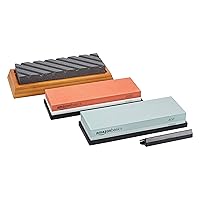
The wucgea set combines 400/1000 and 3000/8000 grit stones with a bamboo base, angle guide, flattening stone, and leather strop. Choose it if you want several grit steps and accessories together; skip it if you only need one medium stone or don't want to store a larger kit.
Soak this stone in water for 5 to 10 minutes before use, as directed for the kit. Keep it on a solid, flat surface in its base, and use the coarsest side only when the edge needs repair.
Is 1,000 grit enough for a home cook?
A 1,000-grit stone is a practical single-stone choice for routine sharpening. It's aimed at medium grinding, making it a good fit for a kitchen knife that's dull but still in sound condition.
The Naniwa Super Stone 1000 is a ceramic water stone with a base and a dressing stone. Choose it if you want a focused medium-grit option from Naniwa; skip it if your main need is repairing chips or polishing an already sharp edge.
Use water while sharpening and follow the stone's care instructions. Place it where it can't slide, keep the surface wet as needed, and use controlled strokes at a consistent angle rather than pressing hard.
For a step-by-step sharpening routine, read how to use a whetstone. A stable base and steady angle are more useful than moving quickly through extra grit levels.
When should you move from 1,000 to 3,000 grit?
Move to 3,000 grit when the edge is already sharp and you want to refine its finish. It's a finishing step after medium sharpening, not a faster way to repair damage.
The Naniwa Chosera 3000 is a ceramic finishing stone with a base and dressing stone. Choose it if you already sharpen on a coarser stone and want a finer step; skip it if one medium grit meets your everyday needs.
You don't need to use 3,000 on every knife or after every sharpening. If the edge cuts well after the medium stone, stop there and save the finishing step for when you want a smoother edge.
Are 8,000 and 12,000 grit useful for kitchen knives?
Grits such as 8,000 and 12,000 are very fine finishing options, not general-purpose starting stones. They suit an edge that's already been sharpened through earlier stages and needs further refinement.
The Naniwa Kagayaki 12000 is intended for super-fine sharpening and a polished finish. It comes with a storage case that can also serve as a sharpening table.
Choose it if you want that fine finishing stage and have the earlier grits; skip it if you need to revive a dull kitchen knife.
A high number doesn't guarantee a sharp edge by itself. If the knife still needs repair or hasn't formed a clean edge at a coarser grit, work through those stages first.
Do whetstone numbers match across brands?
Treat grit numbers as a useful guide, not an exact cross-brand standard. The number signals relative coarseness, but stone material and grit systems can affect how stones behave.
Pair the number with the stone's stated purpose, such as medium grinding or finishing. Also check whether the stone uses water and what care it needs before choosing it.
Our guide to whetstone numbers and what they mean covers common labels. For a broader comparison of stone types, see whetstone vs. oilstone.
How should you set up and care for a whetstone?
Set the stone on a stable, level surface before sharpening, and follow its instructions for water or soaking. A stone that slides or dries out during use makes it harder to control your angle.
Some stones are made for water use, while others have different care needs. Don't assume every stone should be soaked for the same length of time.
The wucgea kit calls for a 5 to 10 minute soak, while the Naniwa Super Stone uses water during sharpening; follow the instructions for whichever stone you buy.
Rinse away sharpening residue and let the stone dry fully before storing it. Keep the work area clear, use light pressure, and avoid leaving a wet stone somewhere it can be damaged or forgotten.
A stone can wear unevenly with use, which makes it harder to keep the blade in contact across its surface. The wucgea set includes a flattening stone; for more on this maintenance step, read how to flatten a whetstone when it dishes.
What common grit mistakes should you avoid?
The most common mistake is choosing a grit that doesn't match the edge. A fine stone is slow for repair, while a coarse stone can remove more material than routine sharpening requires.
Another mistake is assuming that more steps always mean a better result. A simple medium stone can be enough for regular care, and an extra-fine finish only helps if you have a reason to use it.
Don't skip the medium stage when moving from major repair to fine finishing. Progress through the grits in order, and check the edge before moving on so you don't spend time polishing an edge that still needs sharpening.
Finally, don't confuse the printed number with a promise of speed or a specific finish. Use the grit as a starting clue, then consider the stone's material, instructions, and intended purpose.
How many whetstone grits do you actually need?
Most home cooks can start with one medium stone around 1,000 grit. Add a coarse grit if you need to repair damaged edges, or a finer grit if you want a more refined finish.
The wucgea 400/1000 combination gives you a repair and medium step in one kit. Its additional 3000/8000 surfaces suit someone who expects to use finer finishing stages, but they add little value if you only sharpen ordinary kitchen knives.
A single Naniwa Super Stone 1000 makes more sense if you want a dedicated medium stone. The Chosera 3000 and Kagayaki 12000 are better additions for someone who already has a sharpening routine and knows they want finer finishing.
Choose by the work you'll do most often. Buying several high grits before learning to form a consistent edge adds cost and steps without solving the main problem.
Which whetstone numbers should you choose?
Pick the grit that matches the knife's condition and the finish you want. For routine sharpening, start near 1,000; for repair, start coarser; for refinement, move finer after the edge is sharp.
Choose the wucgea kit if you want multiple grit levels and included accessories. Choose the Naniwa Super Stone 1000 if your priority is a focused medium-grit stone, the Chosera 3000 if you want a finishing step, or the Kagayaki 12000 if you specifically want super-fine polishing.
The simplest decision rule for whetstone numbers is coarse for repair, medium for sharpening, and fine for refinement. If you're still comparing stone styles, our kitchen knife sharpening stone guide can help narrow the next choice.
Frequently asked questions
What do the numbers on a whetstone mean?
The number describes the stone's grit, or how fine its abrasive surface is. Lower numbers are coarser and remove metal faster; higher numbers are finer and refine the edge.
Grit systems can vary between stone types and makers, so use the number as a guide rather than a perfect cross-brand measurement.
What whetstone grit should a beginner use?
A 1,000-grit stone is a practical starting point for routine sharpening when a knife is dull but not badly damaged. If the edge has chips or needs substantial repair, a coarser stone can work faster.
A very fine stone is usually for refining an edge, not restoring a neglected one.
Is 3000 grit finer than 1000 grit?
Yes. Within a typical whetstone grit range, 3,000 is finer than 1,000 and is used to refine an edge after the coarser sharpening work.
It removes metal more slowly, so it is not the efficient first choice for a very dull or damaged knife.
Do higher grit whetstones sharpen better?
Higher grit stones leave a finer finish, but that doesn't make them better for every job. A coarse stone repairs or reshapes an edge more quickly, while a medium stone handles routine sharpening.
Choose the finest grit that fits the edge and the finish you want.