Tumbler Pro Rolling Knife Sharpener Review: Worth It? (October 2026)
The Tumbler Pro suits cooks who want a guided rolling sharpener with diamond sharpening and a ceramic honing disc. Its removable discs add options, while its magnetic angle support and rolling method differ from freehand whetstone sharpening.

On this page (8 sections)
- What does the Tumbler Pro include?
- How does the Tumbler Pro sharpen a knife?
- Is the Tumbler Pro a good fit for your knives?
- Tumbler Pro vs. the Original Tumbler
- How does it compare with HORL 3 Cruise and Work Sharp?
- What are the Tumbler Pro's trade-offs?
- Who should choose the Tumbler Pro?
- Frequently asked questions
The Tumbler Pro is a guided rolling sharpener for cooks who want diamond sharpening and ceramic honing in one system. Its removable discs give it an expansion option, while the magnetic angle support helps guide the blade during sharpening.
The key choice is whether you want a rolling tool or a whetstone. Pick the Pro if the guided format and removable disc system suit you; consider the Original Tumbler for its fixed 15° and 20° angle options, or compare other systems if you want more preset angles.
What does the Tumbler Pro include?
The Tumbler Pro comes with a rolling sharpener and magnetic knife holder. The removable disc system uses a 4-layer diamond disc and ceramic honing disc, and it works with optional whetstone discs sold separately.
Tumbler Pro Rolling Knife Sharpener: Best for removable disc options
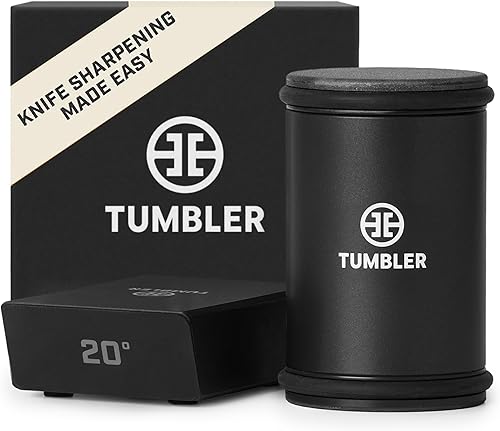
- 4-layer diamond disc
- Ceramic honing disc
- Removable disc system
- Magnetic angle support
A guided rolling system with a diamond disc for sharpening and ceramic disc for honing. Its removable disc system also accepts optional whetstone discs sold separately.
Pros
- Diamond and ceramic discs included
- Removable disc system
- Weighted resin body and magnetic angle support
Cons
- Optional whetstone discs are sold separately
- Check compatibility for specialty edges
The diamond disc sharpens, while the ceramic disc hones and refines the edge. This gives the system two different stages without changing to a separate rod or stone.
Tumbler describes the body as weighted resin and says the magnetic angle support is designed to help keep sharpening consistent. The system is intended for kitchen knives, utility blades and field knives.
How does the removable disc system affect the choice?
The removable discs make the Pro more flexible if you want to add options later. Whetstone discs are optional, so the included setup doesn't include a full set of stone discs.
If you already own whetstones and like working freehand, you may not need the added system. Our guide to sharpening stones for kitchen knives explains the main stone choices and what they offer.
How does the Tumbler Pro sharpen a knife?
The Pro uses a rolling disc and magnetic angle support to guide sharpening. Secure the knife at the support and roll the disc along the blade, then use the ceramic honing disc to refine the edge.
That setup differs from a whetstone, where you move the knife across a flat abrasive surface while maintaining the angle yourself. If the mechanics are new to you, follow our rolling sharpener walkthrough before your first session.
The Pro is described for kitchen, utility and field knives. Check the instructions for compatibility with serrated or specialty blades before using it.
A clean, stable work surface can help you keep the knife supported and your hands clear of the blade path. Work slowly and follow the included instructions for positioning and handling.
Is the Tumbler Pro a good fit for your knives?
The Pro makes the most sense for smooth kitchen and utility blades that fit its guided setup. It targets cooks and outdoor users who want a rolling sharpener with separate sharpening and honing discs.
It may be less suitable if you prefer a flat stone and want to control each sharpening stroke yourself. Our guide on how to use a whetstone walks through the freehand method, including angle control and sharpening stages.
Also think about how much flexibility you need. The Pro's optional whetstone discs add a path for changing discs, but buyers who mainly want a fixed-angle tool may find the Original Tumbler more straightforward.
The rolling sharpener versus whetstone comparison lays out the trade-offs in method, control and routine.
Tumbler Pro vs. the Original Tumbler
The main difference is the disc system. The Pro has a removable disc setup with a ceramic honing disc, while the Original uses a stainless steel helix honing disc and fixed 15° and 20° angle options.
The Original has two fixed angle options. The Pro's removable design matters more if you value optional whetstone discs and want the included ceramic honing disc.
Both use magnetic angle support and diamond sharpening. The decision comes down to which honing surface and disc arrangement you prefer.
For a broader comparison, see HORL vs. Tumbler rolling sharpeners.
That article compares two rolling systems and their different setups.
How does it compare with HORL 3 Cruise and Work Sharp?
The HORL 3 Cruise offers 15° and 20° angles, with a fixed diamond disc and stainless steel honing disc. HORL describes the 15° setting for fine Japanese, carbon and Damascus blades, and the 20° setting for European chef's knives and outdoor or pocket knives.
The Work Sharp Rolling Knife Sharpener has four preset angles: 15°, 17°, 20° and 25°. Work Sharp says its magnetic angle guide holds the blade position, and replacement abrasives are available.
The Pro sits between those choices if removable discs are the main draw. HORL offers two set angles and a steel honing disc, while Work Sharp supplies four angle settings and diamond abrasives.
What are the Tumbler Pro's trade-offs?
The Pro's strongest practical feature is its combination of guided rolling, diamond sharpening and ceramic honing. The removable discs also leave room to add optional whetstone discs later.
Its main limitation is that the additional disc options require separate purchases. If you don't expect to use them, compare the Original's fixed setup or a rolling sharpener with different angle choices.
A rolling format also isn't the same as freehand sharpening. If learning stone technique is part of your goal, the whetstone grit chart can help explain abrasive stages and how they fit into edge maintenance.
Use the tool on blades that match its intended smooth-knife use, and keep a careful grip throughout. For a damaged edge or an unusual blade, check the instructions or seek a sharpening service familiar with that knife.
Who should choose the Tumbler Pro?
Choose the Tumbler Pro if you want a guided rolling system with a diamond disc, ceramic honing disc and optional disc flexibility. It fits a home cook who values a repeatable setup and may want to expand beyond the included discs.
Choose the Original Tumbler if you want its fixed 15° and 20° angle choices with a helix honing disc. Pick the HORL 3 Cruise for its fixed diamond and steel discs at two angles, or Work Sharp if four preset angles are your priority.
For more options across the category, see our best rolling knife sharpeners. Compare the angle setup and abrasive style with the knives you actually use.
Frequently asked questions
Is the Tumbler Pro suitable for beginners?
The Pro is described as beginner friendly and uses magnetic angle support to guide sharpening. You still need to position the knife carefully, follow the instructions and use the tool only with compatible blades; guided support doesn't remove the need for careful handling.
Does the Tumbler Pro sharpen pocket knives?
Tumbler describes the Pro for kitchen knives, utility blades and field knives, and also mentions everyday carry blades. Check the instructions for your specific knife and edge before sharpening, especially if it has a specialty or serrated blade.
Does the Tumbler Pro use water?
The product information doesn't state whether water is needed for the Pro. Follow its included instructions for the diamond and ceramic discs, and don't assume care steps for a whetstone apply to this rolling system.
What should you choose between the Tumbler Pro and a whetstone?
Choose the Pro if you prefer guided rolling and magnetic angle support, with included diamond and ceramic discs. Choose a whetstone if you want to sharpen on a flat stone and are willing to manage the angle yourself; our whetstone walkthrough covers that technique.
Pick the Tumbler Pro for guided rolling and removable disc options; choose another sharpener if its disc setup or intended blade use doesn't match your needs. Compare it with the best rolling knife sharpeners to see how its format fits your sharpening routine.
Frequently asked questions
What comes with the Tumbler Pro?
The Tumbler Pro package includes the rolling knife sharpener and magnetic knife holder. It has a 4-layer diamond disc and a ceramic honing disc; optional whetstone discs are sold separately.
Can the Tumbler Pro use whetstone discs?
Yes, the Pro has a removable disc system designed to work with optional whetstone discs, which are sold separately. Its included setup has diamond sharpening and ceramic honing discs.
How is the Tumbler Pro different from the Original Tumbler?
The Pro includes a 4-layer diamond disc and ceramic honing disc, with a removable disc system for optional whetstone discs. The Original pairs a diamond-plated disc with a stainless steel helix honing disc and has fixed 15° and 20° angle options.
Is a rolling sharpener easier than a whetstone?
A rolling sharpener guides the angle with a magnetic support, which can reduce the need to hold a steady angle by hand. A whetstone uses a different sharpening method and gives you control over your technique; see our walkthrough before deciding which approach fits your routine.