What Grit Sharpening Stone Do You Need?
For most kitchen knives, you need a 1000 grit stone as your everyday sharpener, then a 3000 to 6000 grit stone if you want a polished edge. Drop to 220 to 400 grit only to repair chips or reset a badly dulled bevel.
On this page (9 sections)
- What does the grit number actually mean?
- What grit do you need for a normal dull knife?
- When do you need a coarse 220 to 400 grit stone?
- What does a 3000 to 6000 grit stone add?
- Should you buy a single grit or a combination stone?
- Which grit setup suits each kind of buyer?
- How do you know which grit you already own?
- What grit do you need at each stage of the sharpening job?
- The verdict: pick your grit by the edge, not by the catalog
The grit you need depends on the state of your edge right now. Pick 1000 grit for a knife that is dull but undamaged, 3000 to 6000 grit to polish that edge afterward, and 220 to 400 grit only when you have chips or a badly worn bevel to repair.
Most home cooks buy one stone and stop there, and that is usually the right call, because a single 1000 grit stone covers the everyday job.
If you answer the question "what grit sharpening stone do I need" with a number, the honest answer for a kitchen drawer is 1000.
This guide walks through the grit bands, shows what each one does to a blade, and names the stones we would pick. Our sharpening stone for kitchen knives buyer's guide covers the wider buying picture.
What does the grit number actually mean?
The grit number tells you how coarse or fine the abrasive is, not how good the stone is. Lower numbers cut faster and leave a rougher scratch pattern; higher numbers cut slower and leave a smoother one.
A 220 grit stone is aggressive. It removes metal quickly to reshape a damaged edge, and it leaves visible scratches you can feel with a fingernail.
A 1000 grit stone sits in the middle: fast enough to sharpen a dull knife in a few minutes, fine enough to leave a usable edge.
Numbers above 3000 get into polishing territory. They refine the scratches left by the previous stone and make the edge feel smoother as it cuts.
They do not make the knife stronger or more durable, and they do not replace good technique.
Manufacturers differ in how they grade grit. A 1000 grit from one brand and a 1000 grit from another will not measure exactly the same, so treat the number as a rough guide rather than a scientific scale.
Here is the practical split for home sharpening:
| Grit band | Job | When to use it |
|---|---|---|
| 220–400 | Repair and shaping | Chips, nicks, resetting a bevel |
| 600–1200 | Everyday sharpening | A dull but undamaged edge |
| 3000–6000 | Refining and polishing | After sharpening, for a clean cut |
| 8000 and up | Polishing | Razors and fine edges |
Pick your grit band by the edge in front of you, then choose the stone.
What grit do you need for a normal dull knife?
You need 1000 grit for a normal dull knife. That band brings an edge back to slicing sharpness quickly and leaves a finish that grips food instead of sliding over it.
One-thousand grit is the workhorse of kitchen sharpening. It removes enough steel to rebuild the edge in a reasonable number of passes.
If you sharpen a knife once a month, a 1000 grit stone is the only one you truly need. Coarser stones would remove more metal than necessary and wear your knives faster, and finer stones would slow the job and give you polish before the edge is ready for it.
The 1000 grit finish is also good for everyday cooking. Chefs often like a slightly toothy edge because it bites into tomato skins and crusty bread, and a 1000 grit edge does exactly that.
When the knife still slices paper but drags on a tomato, a few light passes on 1000 grit bring it back. You are not removing damage, just refreshing the edge.
Many knife sharpening stone options start at 1000 grit for this reason. It is the first number most cooks buy, and often the last.
The Naniwa Super Stone 1000 is our pick for a first serious stone. It measures 210 x 70 x 25 mm and sits on a plastic base, so it stays put while you work.
Naniwa says the stone is made for rapid sharpening of stainless and high alloy steels, and its surface has a little give that keeps the blade from skidding. Naniwa also grades it as a medium grit for general cutlery, so it fits the everyday band without overshooting into polish work.
It ships with a dressing stone of about 65 x 47 x 32 mm, which you rub over the surface to refresh the cut when it starts to glaze. That little block is the simplest way to keep a 1000 grit stone working like new between flattening sessions.
The stone comes with instructions that walk through soaking and use, so a first-time sharpener has something to follow.
Buy a 1000 grit stone first and learn the angle on it. Everything else is an upgrade, not a requirement.
When do you need a coarse 220 to 400 grit stone?
Choose a coarse stone only to fix damage or reshape a bevel. It is a repair tool, not a sharpening stone for a healthy edge.
A coarse stone removes metal fast. That is what you want when a knife has a chip, when a blade has been sharpened at a bad angle for years, or when you are setting the first bevel on a new knife.
It is not what you want on a knife that just needs a touch-up.
Watch for these signs that you genuinely need the coarse grit:
- A visible chip or nick in the edge that catches your fingernail.
- A knife so dull it will not cut paper at all.
- A bevel that has rounded over and needs to be reset.
If none of those apply, skip the coarse stone. Using 400 grit on a good edge wears the blade down for no gain, and you still have to follow it with a finer stone to refine the scratches.
Diamond plates are a different route to the same job. A diamond sharpening stone removes metal fast and stays flat, which suits chip repair and bevel setting well.
If your coarse work is occasional, a diamond plate covers it without a long soak.
Reach for 400 grit for damage, not for dullness. A knife that slices food poorly is a 1000 grit job.
What does a 3000 to 6000 grit stone add?
A 3000 to 6000 grit stone refines and polishes the edge left by 1000 grit. It makes the cut smoother and the edge feel sharper, but it will not fix a dull blade on its own.
Think of the coarse and fine stones as two different stages. The 1000 grit stone creates the edge geometry, and the fine stone smooths the scratches at the very apex so the edge cuts cleanly through food.
The practical gains are real but modest for a home cook. A polished edge cuts more smoothly and feels sharper to the touch, and it also tends to leave less tearing on delicate foods.
For a chef dressing a plate, that can matter.
The trade-offs are also real. Fine stones wear more slowly and cut more slowly, so you spend longer on the stone, and they cost more than a comparable 1000 grit.
And if the edge underneath is poorly formed, polishing it just gives you a smooth bad edge.
Use the fine stone as a finishing step after 1000 grit, with light pressure and the same angle you used before. A few passes is enough, because you are refining, not grinding.
Add a fine stone when your technique is reliable and you want a cleaner cut. Until then, a well-used 1000 grit edge beats a poorly used 6000 grit one.
Should you buy a single grit or a combination stone?
Start with a single 1000 grit stone if you sharpen occasionally. Choose a combination stone if you want both a sharpening and a refining stage in one purchase.
A combination stone puts two grits on opposite sides of the same block. It saves money and storage compared with two separate stones, which is why so many first sets are combinations.
The trade-off is thickness: each side is thinner than a standalone stone, so the stone wears out sooner with heavy use.
The KING KW65 combination stone
The KING KW65 is a good example of the format. It measures 8 x 2 1/2 x 1 inch and comes with a sturdy plastic base to hold it steady.
King says to soak it in water and keep it wet while in use, which is standard for water stones. One side sharpens, the other polishes, and you move between them as your edge moves from rough to ready.
The stone is ceramic and rated for fine and ultra fine work, so the two sides cover the sharpening stage and the polishing stage without a third stone. Its size suits a kitchen counter, and the base means you do not need to buy or rig a separate holder.
King lists the same block under its model number 3684, so you can match the part when you shop.
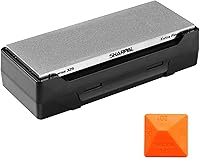
The Sharp Pebble 1000/6000 kit
The Sharp Pebble 1000/6000 kit is the other route into the same grits. It includes a bamboo base, an angle guide and an instruction manual, which helps if holding a steady angle is the part that worries you.
It measures 7.25 x 2.25 x 1 inch and is built around water rather than oil. The angle guide locks the blade position so the stone does more of the work on your first tries.
The kit also lists a tips and tricks ebook and sharpening expert support, which suits a buyer who wants guidance as much as hardware. Sharp Pebble describes the 1000 side as the edge repair grit and the 6000 side as the polish grit, and says the pair covers most home kitchen sharpening without a coarser stone.
For a first kit, that framing is honest: you get both stages and the holder in one box.
Buy a combination stone when you know you will use both grits. If you only ever touch up one knife, the single 1000 grit stone is the simpler buy.
Whichever you choose, keep the surface flat. A flattening stone for whetstone maintenance tells you when the surface has dished and how often to true it, and a dished stone cannot give you a consistent angle or a clean edge.
Which grit setup suits each kind of buyer?
Match the grit to how you cook and how much you care for your knives. These three setups cover almost every home sharpener.
The everyday cook sharpens one or two knives and just wants them to slice. A single 1000 grit stone covers it, so learn the angle on that one stone and get the edge right before adding anything.
The eager home chef keeps a few good knives and wants a clean cut on delicate food. A 1000 and a 6000 grit in a combination stone is the sensible next step, where the 1000 side does the work and the 6000 side finishes.
The repair-and-restore cook buys old knives, fixes chips, or sharpens for family. That buyer needs a coarse stone alongside the 1000: a 220 or 400 grit stone for damage, and 1000 grit for the edge, covers nearly everything.
A fine stone above 6000 is a specialty purchase. It polishes for razors and woodworking tools more than for kitchen knives, so skip it until a 6000 grit stone feels limiting.
Pick your setup by habit, not by ambition. The best grit is the one you will actually use every few weeks.
How do you know which grit you already own?
If a stone is unmarked, you can estimate its grit by feel and by the finish it leaves. A coarse stone feels sandy and leaves deep, visible scratches, while a fine stone feels smooth and leaves a hazy polish.
Run a kitchen knife across the stone with mild pressure and look at the scratch pattern. Deep scratches and fast metal removal point to a coarse stone, likely below 1000, and a fine, even haze points to a polishing stone above 3000.
A light rub with a fingernail tells you a lot. A gritty tug under the nail is a coarser surface, and a slick, almost slippery feel is a fine one.
If the finish is ambiguous, test between the two most common bands. Sharpen on the stone and cut a tomato: a toothy edge that bites suggests around 1000 grit, and a smooth, less grippy edge suggests a finer stone.
You can also compare the stone's size against the known formats here. The Naniwa is 210 mm long and the Sharp Pebble is 7.25 inches long, so a stone in that range is likely a medium or medium-fine block.
A thick block with two colours on its faces is probably a combination stone, which means one side is coarse and one is fine, so check each face separately before you decide what you own.
Treat an unmarked stone as a coarse or medium stone until it proves finer. Sharpen a less valued knife on it first and check the result before trusting it with your best blade.
What grit do you need at each stage of the sharpening job?
The full job runs coarse to fine in order, and each grit has a job it does better than the others. You do not need every stage every time.
For routine maintenance, 1000 grit is the whole job. Use light pressure, keep the angle steady, and stop when the edge bites again, because this is most of what home sharpening looks like.
When you want a finer finish, follow the 1000 with the 6000. Use light passes, the same angle, and check the edge against your thumbnail, since the polish comes from refining the same geometry, not from cutting a new one.
When you have damage, start at the coarse grit and move up. Repair the chip at 220 or 400, sharpen the new edge at 1000, and polish at 6000 if you want one, so each step removes the scratches from the one before.
The mistake many sharpeners make is jumping straight to the fine stone. A polished edge on a badly formed bevel still cuts poorly, and grit order matters more than grit number.
Work coarse to fine, and stop at the grit that gives you the edge you need. Most home cooks can stop at 1000 grit.
The verdict: pick your grit by the edge, not by the catalog
The question "what grit sharpening stone do I need" has a straight answer for most people. Buy 1000 grit first and learn to use it well.
It sharpens dull kitchen knives, leaves a useful toothy edge, and covers nearly every home sharpening job.
Add a 6000 grit stone, or a combination, when you want a cleaner cut and a polished edge. Pick up a coarse 220 to 400 grit stone only when a chip or a worn bevel demands repair.
Your first stone should be a 1000 grit, and the Naniwa Super Stone 1000 is the one we would pick for that role.
Reach for the best diamond sharpening stones if repair and flatness matter more to you than polish. And keep any stone true with a flattening stone for whetstone check whenever the surface stops being flat.
Frequently asked questions
What grit sharpening stone do I need for a kitchen knife?
Start with a 1000 grit stone for everyday kitchen knives. It brings a dull edge back to slicing sharpness without removing much steel.
Add a 3000 to 6000 grit stone later if you want a smoother, polished edge on your best knives.
Can I sharpen a knife with only one grit?
Yes, one 1000 grit stone covers most home sharpening. It handles dull edges and leaves a toothy finish that cuts food well.
You only need a second, finer grit when you want polish, and a coarser one when the edge is chipped.
Is a lower grit number coarser or finer?
A lower grit number is coarser and removes more metal. A higher grit number is finer and polishes more.
So 400 grit repairs an edge, 1000 grit sharpens it, and 6000 grit refines it.
Do I need a 6000 grit stone for everyday cooking?
Not usually. A 6000 grit stone polishes an edge for clean cuts and a smooth feel, but a 1000 grit edge slices tomatoes and meat just fine.
Keep the finer stone for knives you use carefully and want to keep razor sharp.
Should I soak a water stone before sharpening?
Most water stones need a soak until the bubbles stop, then stay wet while you work. King says to soak the KW65 and keep it wet in use.
Follow the maker's directions for your own stone.
How often should I sharpen with each grit?
Use 1000 grit whenever the knife stops biting into food, often every few weeks for a home cook. Reach for a coarse stone only for damage.
Use the fine stone less often, when you want to refresh the polish on a sharp edge.