10 Best Pull-Through Knife Sharpeners (October 2026)
The best pull through knife sharpeners include the Chef'sChoice Manual Knife Sharpener for 15 and 20 Degrees for 15- and 20-degree kitchen edges, the Chef'sChoice Pronto Hone Manual Sharpener for 15-degree Asian-style knives, and the AccuSharp Gourmet 15-Degree Sharpener for 15-degree gourmet knives.
On this page (5 sections)
The best pull-through knife sharpener for most kitchen knives is the Chef'sChoice Manual Knife Sharpener for 15 and 20 Degrees, because it uses diamond abrasives and has separate sharpening and polishing stages. Smith's Adjustable suits knives with different angles, while KitchenIQ Edge Grip is a compact option for a small kitchen.
Pull-through sharpeners guide the blade through an angled slot. Check the supported angle and blade types before use, especially for an unusual knife.
For a careful pass through the process, see our guide to using a pull-through knife sharpener. If you're weighing a manual slot tool against another guided option, our Work Sharp MK2 review covers a different format.
Our picks at a glance
-
1
 Best for 15- and 20-degree kitchen edges
Chef'sChoice Manual Knife Sharpener for 15 and 20 Degrees
8.0/10 our score
See it on Amazon -
2
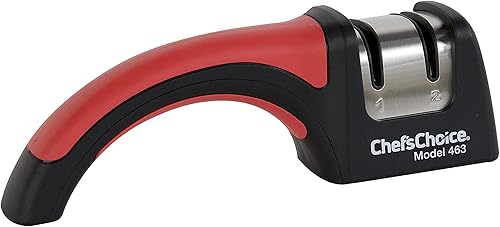 Best for 15-degree Asian-style knives
Chef'sChoice Pronto Hone Manual Sharpener
7.8/10 our score
See it on Amazon -
3
 Best for 15-degree gourmet knives
AccuSharp Gourmet 15-Degree Sharpener
7.7/10 our score
See it on Amazon
- 4
 Check it
Henckels Handheld Knife Sharpener
Best for simple ceramic stages - 5
 Check it
Smith's Adjustable Manual Knife Sharpener
Best for adjustable angle settings - 6
 Check it
KitchenIQ 50009 Edge Grip 2-Stage Sharpener
Best for a compact countertop setup - 7
 Check it
Work Sharp Pull Through Sharpener
Best for diamond sharpening and touch-ups - 8
 Check it
Zwilling 4-Stage Sharpener With Scissor Slot
Best for knives and scissors - 9
 Check it
Lansky D-Sharp Diamond Sharpener
Best for angle options in a pocket tool - 10
 Best for a small outdoor kitCheck it
How we chose these pull-through knife sharpeners
The best pull-through knife sharpeners match the knife angle and blade type while offering useful control over sharpening and finishing. We compared the stated stages, abrasive types, angle options, safety features, and intended uses.
Models with separate coarse and fine stages can cover both a dull edge and a light touch-up. Adjustable angles can help if your knives use more than one bevel, while a fixed-angle sharpener keeps the choice simple when its angle matches your blade.
We also considered practical details such as a non-slip base, finger guard, compact storage, and replaceable sharpening components. Our score weighs specs and features against what you're shopping for.
| Product | Best for | Our score |
|---|---|---|
| Chef'sChoice Manual Knife Sharpener for 15 and 20 Degrees | 15- and 20-degree kitchen edges | 8.0 |
| Chef'sChoice Pronto Hone Manual Sharpener | 15-degree Asian-style knives | 7.8 |
| AccuSharp Gourmet 15-Degree Sharpener | 15-degree gourmet knives | 7.7 |
| Henckels Handheld Knife Sharpener | simple ceramic stages | 7.7 |
| Smith's Adjustable Manual Knife Sharpener | adjustable angle settings | 7.6 |
| KitchenIQ 50009 Edge Grip 2-Stage Sharpener | a compact countertop setup | 7.5 |
| Work Sharp Pull Through Sharpener | diamond sharpening and touch-ups | 7.4 |
| Zwilling 4-Stage Sharpener With Scissor Slot | knives and scissors | 7.3 |
| Lansky D-Sharp Diamond Sharpener | angle options in a pocket tool | 7.3 |
| Smith's CCKS 2-Step Sharpener | a small outdoor kit | 7.0 |
The best pull-through knife sharpeners
These pull-through sharpeners address different needs, from dual-angle kitchen sharpening to portable tools for outdoor blades. Start with the edge angle and knife type, then compare the stages and handling features.
Chef'sChoice Manual Knife Sharpener for 15 and 20 Degrees: Best for 15- and 20-degree kitchen edges
- Diamond abrasives
- Separate sharpening and honing stages
- For straight-edge and serrated knives
Separate sharpening and polishing stages make this the most versatile fit here for kitchen knives with 15- or 20-degree edges. It also supports serrated blades.
Pros
- Two angle classes
- Diamond abrasives across the stages
- For straight-edge and serrated knives
Cons
- Best suited to knives in its stated angle classes
The Chef'sChoice Manual Knife Sharpener for 15 and 20 Degrees is the most flexible kitchen pick here for knives built around either of those edge angles. Its diamond abrasives are used for sharpening and honing, followed by a polishing stage with micron-sized diamond abrasives.
Separate sharpening and honing stages suit someone who wants more than a single coarse pass. Chef'sChoice says its CrissCross design sharpens from both directions to create an edge with bite.
The sharpener is intended for straight-edge and serrated knives, plus sports and pocket knives. Its compact body and soft-touch handle are useful for keeping the tool steady on a counter.
Choose it if your kitchen knives use 15- or 20-degree edges and you want distinct sharpening and polishing steps. Check your knife's recommended angle first, since the two angle classes are the key fit.
Chef'sChoice Pronto Hone Manual Sharpener: Best for 15-degree Asian-style knives
- 15-degree edge
- Two diamond abrasive stages
- For straight-edge and serrated knives
The two-stage design sharpens and then hones or polishes 15-degree knives. It's a direct fit for double-bevel Asian-style blades.
Pros
- Two stages
- Diamond abrasives in both stages
- For straight-edge and serrated knives
Cons
- Focused on 15-degree edges
Chef'sChoice Pronto Hone is built around a 15-degree edge for Asian-style and Santoku knives. It has two stages, with diamond abrasives used for sharpening and honing or polishing.
Chef'sChoice describes the edge as an arch shape with bite, and the tool is also intended for straight-edge and serrated double-bevel Asian-style blades. That makes the angle and blade type the main compatibility checks.
Its two-stage layout is straightforward if you want to sharpen and then refine in one tool. For knives with a 20-degree edge, choose a model that supports that angle instead.
This is the pick for compatible 15-degree Asian-style knives, especially when you want a dedicated two-stage tool.
AccuSharp Gourmet 15-Degree Sharpener: Best for 15-degree gourmet knives
- 15-degree edge focus
- Reversible diamond-honed tungsten carbide blades
- Finger guard
This handheld sharpener is aimed at 15-degree gourmet knives. Its reversible blades and full-length finger guard are useful details for buyers who want a simple, focused tool.
Pros
- Made for 15-degree knives
- Reversible sharpening blades
- For straight-edge and serrated gourmet knives
Cons
- No separate fine stage is specified
AccuSharp's Gourmet 15-Degree Sharpener is aimed at knives with a 15-degree edge. Its handheld design has a full-length finger guard, and the diamond-honed tungsten carbide blades can be reversed.
The sharpener is designed for straight-edge and serrated gourmet knives. Its reversible blades are designed to double their lifespan, and the handle provides a secure grip.
This is a focused option rather than an adjustable system. Pick it for compatible 15-degree gourmet knives and confirm the knife's edge angle before sharpening.
Henckels Handheld Knife Sharpener: Best for simple ceramic stages
- Coarse and fine ceramic grits
- Safety grip
- Rubberized non-slip base
Labeled coarse and fine ceramic stages keep the sharpening sequence simple. The safety grip and rubberized base add stability while you draw the blade through.
Pros
- Two labeled stages
- Contoured handle
- Non-slip base
Cons
- No angle adjustment specified
The Henckels Handheld Knife Sharpener uses labeled coarse and fine ceramic stages, so the sequence is clear. A contoured handle, safety grip, and rubberized non-slip base support a steady grip.
This is a simple fit for someone who wants a handheld sharpener without angle controls to adjust. The stated details support use as a general kitchen tool, but they don't specify an angle range.
Pick Henckels if labeled ceramic stages and a steady base matter most. Check that its fixed setup suits your knives before sharpening them.
Smith's Adjustable Manual Knife Sharpener: Best for adjustable angle settings
- Six angle settings from 14 to 24 degrees
- Coarse and fine stages
- Replaceable carbide and ceramic components
Six angle settings give you more choice than fixed-angle models. Replaceable carbide and ceramic components can extend the sharpener's useful life.
Pros
- Six angle choices
- Coarse and fine stages
- Replaceable abrasive components
Cons
- Serrated blades use a separate fixed-angle slot
Smith's Adjustable Manual Knife Sharpener stands out for its six angle settings from 14 to 24 degrees. Turn the dial to match the knife's edge, then draw it through the coarse or fine slot.
The model also includes a fixed-angle slot for serrated blades. Its non-slip base and soft-grip handle support a steady pull, and Smith's says the carbide and ceramic components can be replaced.
This range makes it a good fit for households with a mix of straight-edge knives. It can also sharpen outdoor blades such as fillet and pocket knives.
Choose it if angle selection matters more than compact storage. For serrated knives, use the separate fixed-angle slot and follow the tool's directions.
KitchenIQ 50009 Edge Grip 2-Stage Sharpener: Best for a compact countertop setup
- Coarse carbide and fine ceramic stages
- V-shaped edge grip
- For straight-edge and serrated knives
The edge grip lets you place the sharpener at a counter or table edge, which can help keep a larger knife tip clear of the work surface. Its small body also stores easily.
Pros
- Coarse and fine stages
- Edge grip for countertop edges
- Compact size
Cons
- Preset angle rather than an adjustable angle
KitchenIQ's Edge Grip 2-Stage Sharpener is a compact option with coarse carbide blades and fine ceramic rods. The coarse stage is meant for dull or damaged edges, while the fine stage can hone an already sharp knife.
Its V-shaped base lets you position the tool at a countertop edge, which can help keep a larger knife tip from dragging across the surface. The preset angle keeps use simple, and the body fits in a drawer.
KitchenIQ says it works with straight-edge and serrated knives. Choose it for a small kitchen or drawer where you want a compact two-stage tool and don't need angle adjustment.
Work Sharp Pull Through Sharpener: Best for diamond sharpening and touch-ups
- Coarse and fine stages
- Diamond grinding
- For chef, paring, utility, and serrated knives
The two-stage tool uses diamond grinding to sharpen and refine kitchen knives. It's a practical match for cooks who want a compact tool for several blade types.
Pros
- Diamond grinding
- Two stages
- Compact countertop footprint
Cons
- No adjustable angle setting specified
Work Sharp's Pull Through Sharpener has coarse and fine stages and uses diamond grinding. The coarse slot is intended to bring back a dull edge, followed by the fine stage to refine it.
The tool is designed for chef, paring, utility, and serrated kitchen knives. Its compact footprint can stay near a cutting board or fit in a drawer between uses.
Work Sharp describes diamond grinding as an even way to sharpen an edge. Choose this model for a compact kitchen sharpener with two stages and the blade types it names.
Zwilling 4-Stage Sharpener With Scissor Slot: Best for knives and scissors
- Coarse and fine ceramic slots
- Slots for Japanese and Western blades
- Separate scissor slot
The labeled slots cover Japanese and Western knives, with an extra slot shaped for scissors. Its safety grip and non-slip base help keep fingers clear and the tool steady.
Pros
- Separate slots for Japanese and Western blades
- Scissor slot
- Non-slip rubberized bottom
Cons
- More slots to choose between than a simple two-stage sharpener
Zwilling's sharpener separates its slots by blade style, with coarse and fine ceramic options for Japanese and Western knives. A fifth slot is shaped for scissors, giving it a distinct role among the kitchen-focused picks.
Its labeled slots make the sequence easier to follow, while a safety grip helps keep fingers away from the blade. A rubberized bottom helps keep the tool stable as you draw a knife through.
Pick Zwilling if you want a dedicated scissor slot alongside knife sharpening. Confirm which slots suit your knife type before use.
Lansky D-Sharp Diamond Sharpener: Best for angle options in a pocket tool
- Four angle choices from 17 to 30 degrees
- 600-grit medium diamond pull-through slots
- Ceramic benchstone for polishing and serrations
Four angle choices and a medium diamond pull-through slot offer more control in a compact metal tool. The ceramic benchstone also handles fine polishing and serrations.
Pros
- Four angle choices
- Diamond pull-through slots
- Ceramic benchstone
Cons
- No coarse pull-through slot specified
The Lansky D-Sharp gives you four angle choices: 17, 20, 25, and 30 degrees. Its 600-grit medium diamond pull-through slots handle sharpening, while a ceramic benchstone is included for fine polishing and serrations.
A durable metal casing and compact shape suit a drawer, workbench, or field kit. The combination of pull-through slots and a small benchstone makes it less like a basic single-purpose kitchen sharpener.
Choose it if you want several angle options and a ceramic surface for finishing. It does not specify a coarse pull-through slot, so consider another model for very dull edges.
Smith's CCKS 2-Step Sharpener: Best for a small outdoor kit
- Coarse tungsten carbide and fine ceramic stages
- Compact handheld body
- Lanyard hole
This small sharpener is made for portable use with pocket, hunting, and fillet knives. Coarse carbide and fine ceramic stages cover edge restoration and touch-ups.
Pros
- Compact and lightweight
- Two stages
- Lanyard hole
Cons
- Small format may be less comfortable for kitchen-counter sharpening
Smith's CCKS 2-Step Sharpener is a small portable tool for pocket, hunting, and fillet knives. Its coarse tungsten carbide slot is intended to restore a dull edge, while crossed ceramic rods provide a fine finishing step.
A lanyard hole, non-slip feet, and compact body suit a tackle box or outdoor pack. Smith's says the sharpener floats, which may be useful near water.
Pick the CCKS for portability and outdoor knives. Its small handheld shape is less suited to a dedicated countertop setup than the larger kitchen models.
How do you choose a pull-through knife sharpener?
Choose a pull-through sharpener by matching its angle and slots to your knives, then decide whether you need a coarse stage, a fine stage, or both. A tool that doesn't fit the edge angle can remove material in a way you don't want.
Which angle should a pull-through sharpener use?
Use the angle recommended for your knife. A 15-degree tool may suit some Asian-style knives, while many kitchen tools offer 20-degree options or a broader adjustable range.
If you have several knives, an adjustable model such as Smith's can cover more angles. For a fixed-angle sharpener, check your knife's manual or maker guidance before use.
Do you need coarse and fine stages?
A coarse stage is useful when an edge is quite dull, while a fine stage can refine or touch up an edge that's already in reasonable shape. Use light, controlled pulls and stop when the knife cuts as needed.
Some sharpeners combine these stages with different abrasive materials. For example, KitchenIQ pairs carbide with ceramic, while Work Sharp uses diamond grinding.
Can one tool sharpen serrated knives?
Some pull-through tools include a slot or method for serrated blades, but not all do. Check for explicit serrated-knife support and use the designated slot or surface.
If you also want a non-sharpening maintenance option between sessions, our guide to using a honing rod explains when that tool may help. For broader context on abrasive choices, see our whetstone grit chart.
Pull-through sharpeners versus whetstones
A pull-through sharpener guides the blade through an angled slot. A whetstone requires you to guide the blade across a flat surface.
Pull-through models can be useful for routine home sharpening when the tool matches the knife. A whetstone takes practice, but it can suit users who want to manage the sharpening angle by hand and work across different blade shapes.
Read our kitchen knife sharpening stone guide if you are considering a stone instead. For step-by-step stone technique, see how to use a whetstone.
Which pull-through sharpener should you choose?
Choose the Chef'sChoice Manual Knife Sharpener for 15 and 20 Degrees if you have compatible kitchen knives and want distinct sharpening and polishing steps. Pick Chef'sChoice Pronto Hone for compatible 15-degree Asian-style knives, AccuSharp Gourmet for a 15-degree handheld option, or Henckels for labeled ceramic stages.
Check each knife's angle and blade type before sharpening. If you want to maintain an edge between sharpening sessions, compare the options in our best honing rods guide.
Our top 3 picks at a glance
-
1
Best for 15- and 20-degree kitchen edges
Chef'sChoice Manual Knife Sharpener for 15 and 20 Degrees
8.0/10 our score
See it on Amazon -
2
Best for 15-degree Asian-style knives
Chef'sChoice Pronto Hone Manual Sharpener
7.8/10 our score
See it on Amazon -
3
Best for 15-degree gourmet knives
AccuSharp Gourmet 15-Degree Sharpener
7.7/10 our score
See it on Amazon
Frequently asked questions
Are pull-through knife sharpeners good for kitchen knives?
Yes, a pull-through sharpener can be a convenient choice for routine kitchen knife care. Choose one that matches your knife's edge angle and blade type, and follow its instructions.
For more control over how much metal you remove, a whetstone gives you a different sharpening approach.
Can you use a pull-through sharpener on serrated knives?
Some models support serrated knives, but the slot and method vary. Chef'sChoice, KitchenIQ, and several other picks here state that they work with serrated blades.
Check the instructions for your sharpener and use a slot designed for that blade type.
Do pull-through sharpeners work on Japanese knives?
Some do, especially models made for 15-degree edges or that provide separate Japanese-style slots. Chef'sChoice Pronto Hone is designed around a 15-degree edge, while Zwilling has slots for Japanese blades.
Check the knife maker's recommended angle before sharpening.
How often should you use a pull-through knife sharpener?
Use a pull-through sharpener when the blade needs sharpening, rather than on a fixed schedule. A fine stage may suit a light touch-up, while a coarse stage is for a duller edge.
Use a honing rod between sharpening sessions to realign an edge when appropriate.


