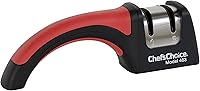
How to Use a Hand Held Knife Sharpener
To use a hand held knife sharpener, rest it on a stable non-slip surface and pull the blade through the slot in one steady stroke, guiding the edge away from your hand. Use the coarse slot to restore a dull edge and the fine slot to hone an edge that already cuts.
On this page (10 sections)
- What do you need before you start sharpening?
- How do you set up a hand held sharpener safely?
- How do you pull the knife through the sharpener?
- How many strokes does a knife need?
- Which hand held sharpener suits your knives?
- How do you sharpen different blade shapes?
- How do you clean and store the sharpener?
- When should you use a stone instead?
- Common mistakes to avoid
- How to use a hand held knife sharpener: the short version
To use a hand held knife sharpener, rest it on a stable non-slip surface and pull the blade through the slot in one steady stroke, guiding the edge away from your hand. Use the coarse slot to restore a dull edge and the fine slot to hone an edge that already cuts.
The tool is simple, but a few habits decide whether the edge improves or gets chewed. This guide walks through setup, stroke technique, stage choice, blade care and storage.
What do you need before you start sharpening?
A stable countertop, a clean knife and the sharpener's instructions are all you need. Keep a towel and a test sheet of paper within reach.
Set the sharpener on a dry, flat counter with the base fully in contact. A wet or cluttered surface lets the tool slide while your hand is close to the blade.
Read the label first, because most hand held sharpeners mark which slot is coarse and which is fine.
Lay the knife flat and check the edge for chips or dents. A hand held sharpener handles a dull but intact edge well; a chipped edge needs more work than a pull-through slot can do.
Wipe the blade so food residue doesn't clog the rods.
How do you set up a hand held sharpener safely?
Hold the sharpener steady with your non-dominant hand and keep your cutting hand clear of the slot. Place it so the slots face away from your body and you can reach them without leaning.
Grip the base or the contoured handle firmly. A rubberized base stays put better on a smooth counter than on a damp cloth.
Don't rest the sharpener on the edge of a plate or a tilted board.
Keep the blade edge pointing away from your fingers and your body. The stroke should move the knife forward and down, not toward your palm.
Stop and reset your grip if your hand drifts toward the slot.
How do you pull the knife through the sharpener?
Draw the blade through in one smooth stroke from heel to tip, keeping the blade level with the slot. Lift the knife, return to the heel and repeat rather than scrubbing back and forth.
Start at the heel, the section nearest the handle. Apply light downward pressure and pull toward the tip at an even speed.
The sharpener's rods set the angle, so your job is to keep the blade straight and the stroke steady.
Do a few strokes in the coarse slot, then a few in the fine slot. Switch sides so both edges get the same treatment on a double-bevel blade, and count strokes so the two sides match.
Don't press hard or twist the blade inside the slot. Excess force digs the edge into the rods and leaves a rough, uneven bevel.
Let the rods do the work.
How to use a pull through knife sharpener's stages
Coarse restores, fine hones. Run a dull edge through the coarse slot first to reset the bevel, then finish in the fine slot to polish the edge.
An edge that already slices only needs the fine slot.
On a 2-stage tool such as the KitchenIQ 50009 Edge Grip 2-Stage Sharpener, the carbide slot is the coarse stage and the crossed ceramic rods are the fine stage. KitchenIQ says the angles are pre-set, so the stage choice replaces the guesswork.
Our guide to how to use a pull through knife sharpener goes deeper on slot order and stroke count.
The KitchenIQ's patented V edge grip lets it sit on the edge of a counter or table. That helps with long blades whose tips would otherwise drag on the surface.
It's small enough for a drawer, so it suits a kitchen with little storage.
Skip it if you want one tool for heavy reshaping. A pull-through slot touches up an edge; it doesn't replace a stone for repairs.
How many strokes does a knife need?
Start with two to five strokes per slot and test the edge before adding more. Fewer strokes protect the blade; a knife that already cuts needs only a pass in the fine slot.
Check the edge on paper after the first round. If the blade drags or tears instead of slicing, add a couple more coarse strokes and repeat the fine slot.
If it slices cleanly, stop.
Every stroke removes a little metal, and extra strokes shorten the blade's life without improving the cut. A light touch with the fine slot between uses keeps an edge ready without wearing it down.
Which hand held sharpener suits your knives?
The AccuSharp is the most versatile pick for mixed knife drawers, the Henckels suits cooks who want a simple two-stage tool, and the KitchenIQ fits small kitchens. Match the tool to the blades you own and the space you have.
AccuSharp Hand-Held Carbide Blade Sharpener
The AccuSharp is a carbide pull-through tool that AccuSharp says sharpens straight and serrated blades, including chef's knives, paring knives and cleavers. Its diamond-honed tungsten carbide blades can be reversed to double their life.
A full-length guard sits between your fingers and the blade.
The two-pack means a spare for a toolbox or a camping kit. Its ergonomic handle fits either hand, so left-handed cooks get the same grip.
AccuSharp says the sharpening blades can be reversed to double their life.
Skip it if you want a fine ceramic hone for daily touch-ups. Carbide removes metal faster and leaves a coarser edge than ceramic rods.
Henckels Handheld Knife Sharpener
The Henckels is a 2-stage sharpener with coarse and fine ceramic grits. Its contoured handle and safety grip keep fingers away from the blade, and the rubberized base holds the tool steady on the counter.
Henckels says it suits both left- and right-handed use.
Ceramic grits cut more gently than carbide, so this tool is a good fit for cooks who sharpen often and want to keep more steel on the blade. The 8-ounce body and wide base make it stable without a clamp.
Skip it if you sharpen very dull or damaged blades often. A carbide coarse stage resets an edge faster, and this model's coarse stage is ceramic.
KitchenIQ 50009 Edge Grip 2-Stage Sharpener
The KitchenIQ is the smallest of the three and the easiest to store. Its coarse carbide slot handles dull and damaged edges, and the fine ceramic rods polish an edge that already cuts.
Non-slip feet and a soft rubber handle help you keep it steady.
Pick it if drawer space is tight or you sharpen at the edge of the counter. Its pre-set angles keep the blade at the right angle without you judging it.
It's also light enough to pack for a rental kitchen.
Skip it if you want a larger handle to grip with both hands. The compact body suits one-handed holding only.
How do you sharpen different blade shapes?
Straight edges run cleanly through a slot, while serrated, single-bevel and very thin blades need care or a different tool. Check the maker's guidance for each blade type before you start.
Straight chef's knives and paring knives are the easy case. Pull them through heel to tip in even strokes.
A long blade needs a smooth, continuous pass so the tip doesn't drag.
Serrated knives only belong in a slot labeled for them. The teeth can catch on the rods and the slot can round the points.
Many cooks leave serrated edges to a rod or a serrated-specific tool.
Single-bevel blades, such as traditional Japanese knives, have an edge on one side only. A pull-through slot sharpens both sides and can spoil the geometry.
Keep those blades on a stone or a guided system. Thin, flexible fillet knives bend in the slot, so use light pressure and short strokes or sharpen them on a stone.
How do you clean and store the sharpener?
Rinse or wipe the slots after use and dry the tool fully before storage. Metal dust and food residue build up in the rods and can transfer to the next blade.
Follow the maker's cleaning instructions. Some models can go under running water; others only need a wipe.
Dry the slots with a cloth or let them air dry fully, since trapped moisture can rust steel parts.
Wipe the knife blade after sharpening too. Fine metal dust left on the edge ends up in food or on the cutting board.
Wash and dry the knife as usual.
Store the sharpener in a drawer or on a shelf where the slots stay clean and dry. Keep it away from the sink's splash zone.
A dry tool with clear slots is ready when you need it.
When should you use a stone instead?
Use a stone or a guided system for chips, reprofiling and a polished edge, and keep the hand held sharpener for quick touch-ups. The pull-through tool is a maintenance shortcut, not a repair bench.
A hand held sharpener works at a fixed angle set by its rods. That angle may not match your knife's factory bevel, and repeated use slowly changes the edge geometry.
For most kitchen knives that's fine, and the speed is worth it.
Reach for a stone when the edge has visible chips, when the blade needs thinning behind the edge, or when you want a mirror polish. Those jobs need angle control and grit choice that a slot can't give.
Many cooks keep both. The pull-through handles the weekly hone and the stone comes out for the annual reset.
If you're comparing quick options, our roundup of the best pull through knife sharpeners covers the field.
How to use a rolling knife sharpener instead
A rolling sharpener runs the abrasive under a fixed blade rather than pulling the blade through a slot. You set the knife flat on a base and roll the sharpener across the edge.
It gives more angle control than a pull-through tool. Our guide to how to use a rolling knife sharpener explains the motion and the angle settings.
When an electric sharpener makes more sense
An electric sharpener powers the abrasive and holds the angle for you. It suits households that sharpen several knives a week or cooks who find hand strokes hard on the wrist.
See our picks for the best electric knife sharpener for home use if speed matters more than a small footprint.
Common mistakes to avoid
Most damage comes from too much pressure, the wrong slot and a sharpener that slides. A few simple habits prevent all three.
- Pressing hard to speed up the job. Let the rods work and keep the pressure light.
- Starting in the fine slot on a dull blade. Reset the edge in the coarse slot first.
- Sharpening only one side. Alternate strokes so the bevel stays even.
- Using a wet or tilted base. Dry the counter and set the sharpener flat.
- Running a serrated or single-bevel blade through a slot not meant for it.
- Forgetting to wipe the blade and clean the slots afterward.
How to use a hand held knife sharpener: the short version
To sharpen with a hand held tool, set it on a dry, stable counter, hold the base with one hand and pull the blade heel to tip in steady strokes. Use the coarse slot on a dull edge and the fine slot to finish, then test on paper and wipe the blade.
Pick the AccuSharp for mixed straight and serrated blades and a guarded grip. Pick the Henckels for a two-stage ceramic tool with a contoured handle.
Pick the KitchenIQ when drawer space is short or you sharpen at the counter's edge. For a comparison of the quick options, read our pull through knife sharpener guide next.
Frequently asked questions
How do you hold a knife when using a hand held sharpener?
Hold the knife handle firmly with one hand and keep the blade flat and level with the slot. Guide the blade away from your body and keep your other hand on the sharpener's base or handle, clear of the cutting path.
How many strokes does it take to sharpen a knife?
Start with a few strokes in the coarse slot, then a few in the fine slot, and test the edge on paper. Two to five strokes per side is a common starting point; very dull blades need more, and an edge that already cuts only needs the fine slot.
Can you sharpen serrated knives in a hand held sharpener?
Some models label serrated knives as suitable and others do not. Check your sharpener's instructions before you run a serrated edge through a slot, since the teeth can catch and the slot may round the points.
Should you wash a knife right after sharpening it?
Yes. Wipe or wash the blade to remove metal dust and grit left by the sharpener, then dry it fully.
Rinse the sharpener's slots under running water when the maker allows it, and dry it before storage.
Does a hand held sharpener replace a whetstone?
No. A hand held pull-through sharpener resets and hones an edge quickly, but it removes metal at a fixed angle and cannot reshape a badly damaged edge.
For chips, reprofiling or a polished edge, use a stone or a guided system.