7 Best Electric Knife Sharpeners for Home Use (November 2026)
The best electric knife sharpeners for home kitchens include the Northmas Knife Sharpener for most home kitchens, the Presto 08800 EverSharp Electric Knife Sharpener for simple two-step sharpening, and the Presto 08810 Professional EverSharp Electric Knife Sharpener for mixed blade thicknesses.
On this page (7 sections)
- The best electric knife sharpeners for home kitchens
- How these electric knife sharpeners compare
- What should you check before buying an electric knife sharpener?
- How many stages does a home sharpener need?
- Does voltage and counter space matter for a home sharpener?
- What is the difference between a slot and a belt sharpener?
- Which sharpener suits your kitchen?
The best electric knife sharpener for home use is the Northmas Knife Sharpener, because it sharpens and polishes in two stages and still fits in a crowded kitchen drawer. Pick the Presto 08810 if your block mixes thick chef's knives with thin paring blades, or the Chef'sChoice 15XV if you want a 15-degree edge.
An electric sharpener takes the guesswork out of holding an angle. You draw the blade through a slot or along a belt, and the machine keeps the bevel steady.
That is the whole appeal for a home cook who wants a usable knife in under a minute.
The trade-off is control. A fixed-angle slot machine is fast and forgiving, while a belt model with an angle dial does more but asks more of you.
This guide sorts the seven machines we compared by the kitchen job each one does best.
If you would rather keep it manual, our guide to how to use a pull through knife sharpener covers the hand-held version of the same idea. For a compact countertop option with more angle choice, see how to use a rolling knife sharpener.
Our picks at a glance
-
1

-
2
 Best for simple two-step sharpening
Presto 08800 EverSharp Electric Knife Sharpener
9.6/10 our score
See it on Amazon -
3
 Best for mixed blade thicknesses
Presto 08810 Professional EverSharp Electric Knife Sharpener
9.3/10 our score
See it on Amazon
- 4
 Check it
Chef'sChoice 15XV EdgeSelect Electric Sharpener
Best for 15-degree edges - 5
 Best for small kitchensCheck it
- 6
 Best for adjustable anglesCheck it
- 7
 Check it
Work Sharp E2 Electric Sharpener
Best for first-time sharpeners
The best electric knife sharpeners for home kitchens
The Northmas wins for most homes because it covers sharpening and polishing in one small body. Every other pick here earns its place on a specific need: blade thickness, edge angle, space or a whole block of knives.
Northmas Knife Sharpener: Best for most home kitchens
- Two-stage sharpening and polishing
- 100V–240V global voltage
- 1.2 lb body, 7.8 x 2.1 x 3.1 in
- Four suction feet
A small two-stage unit that sharpens in seconds, runs on any voltage and stores in a drawer. It is the easiest pick for a typical kitchen.
Pros
- Fits in a crowded kitchen drawer
- Works on 100V–240V power
- Sharpens and polishes in two stages
Cons
- Plastic body
- Fine stage only finishes the edge
Northmas suits the cook who wants the knife block back in shape without a new counter appliance. The two-stage system grinds a fresh edge in the coarse slot and polishes it in the fine slot, so you finish with a burr-free edge rather than a rough one.
Northmas puts the job at about 30 seconds, with 2 to 5 pulls per slot, which is faster than the back-and-forth of a manual stone.
At 1.2 lb and 7.8 by 2.1 by 3.1 inches, it stores in a drawer. The oblique pull angle takes a few tries to get used to: keep the blade flat against the outside wall and draw it from outside to inside.
Global voltage is the quiet advantage. It runs on 100V–240V, so it works in a vacation rental or a home abroad without a converter.
Four suction feet hold it steady, and Northmas says the motor keeps a stable speed without overheating. The trade-off is the plastic body, which does not feel as solid as the Chef'sChoice.
For a first electric sharpener in a normal kitchen, that balance is hard to beat.
Presto 08800 EverSharp Electric Knife Sharpener: Best for simple two-step sharpening
- Two-stage system
- Sapphirite sharpening wheels
- Precision blade guides
- Non-slip base with three suction cups
Draw a non-serrated blade through each slot a few times and you get a fresh edge. The guides set the angle so you only have to keep the knife level.
Pros
- Preset angle guides
- Two receptacles catch metal filings
- Sharpens most non-serrated blades
Cons
- 120 volts only
- Larger counter footprint
Presto's 08800 is the two-step machine for anyone who wants sharpening to be boring. Two stages do the work: the coarse side grinds a precise angle, and the fine side hones and polishes.
Precision guides hold the blade at the set angle, so your only job is to keep the knife level and draw it slowly toward you.
The Sapphirite wheels are the same ultra-hard material professional sharpening shops use, and they suit alloy, carbon and stainless blades. It is normal to see sparks on high-carbon steel.
Three suction cups hold the base down, and two receptacles underneath catch the metal filings.
It is for non-serrated blades only.
The limits are the 120-volt motor and the 3 lb, 9.9-inch body, which needs real counter space rather than a drawer. Choose it over the Northmas if you want the simplest two-slot routine and don't need travel voltage.
Skip it if your knives are all serrated or if counter space is tight.
Presto 08810 Professional EverSharp Electric Knife Sharpener: Best for mixed blade thicknesses
- Three-stage system
- Blade thickness selector in thick, medium and thin
- Extra-fine-grit ceramic wheel
- Sharpens Santoku knives
The thickness selector adjusts the guides for hunting knives, chef's knives or light fillet and paring blades. That makes it the pick for a drawer with mixed steel.
Pros
- Thickness selector for different blades
- Ceramic wheel hones to a fine edge
- Handles Santoku knives
Cons
- Heaviest Presto here
- 120 volts only
The 08810 is the Presto to pick when your knife drawer is a mix. A blade thickness selector adjusts the guides to thick, medium or thin, so a hunting knife, a chef's knife and a fillet knife each get a sensible angle in the same session.
It also handles Santoku blades, which many slot sharpeners do not.
Three stages take it further than the 08800. Coarse grinding starts the edge, a finer stage hones it, and an extra-fine-grit ceramic wheel polishes it to a razor edge.
The guides keep the angle fixed throughout, so there is no guesswork. Presto rates the three settings against blade jobs: thick for hunting knives, medium for chef's knives and standard kitchen blades, thin for light fillet and paring knives.
At 5.1 lb it is the heaviest Presto here and the least likely to slide, helped by suction feet. The cost is bench space and a 120-volt-only motor.
Pick it over the 08800 if you sharpen more than one blade type or want the ceramic finishing stage. Stay with the 08800 if your knives are all standard kitchen steel and you want the smaller, lighter machine.
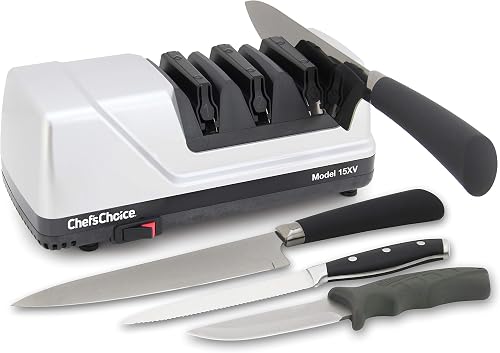
Chef'sChoice 15XV EdgeSelect Electric Sharpener: Best for 15-degree edges
- Three-stage EdgeSelect system
- 100 percent diamond abrasives
- Flexible spring guides
- Handles straight and serrated blades
Chef'sChoice converts a 20-degree factory edge into a 15-degree Trizor XV edge. It suits cooks who want a sharper cutting geometry and serrated blades in one machine.
Pros
- Diamond abrasives in stages 1 and 2
- Spring guides adjust the angle
- Works on serrated knives
Cons
- Premium price tier
- 15-degree edge needs more care on hard use
Chef'sChoice builds the 15XV for cooks who want a keener edge geometry than the 20-degree factory bevel most knives ship with. Stages 1 and 2 use 100 percent diamond abrasives to sharpen and hone, and stage 3 uses a flexible abrasive system to polish and help prolong the life of serrated knives.
The 15-degree Trizor XV edge cuts with less effort than a 20-degree edge. The trade-off is durability: a thinner edge needs more care around bones and hard boards.
The 15XV converts a traditional 20-degree edge into that 15-degree profile, so it changes how your knives behave. The first full sharpening takes about a minute, and resharpening takes about 10 seconds.
Patented flexible spring guides adjust automatically to keep the angle accurate along the whole blade. It handles straight and serrated blades in one machine, which the two-stage slot models here do not.
The 15XV is the premium pick in this group. Choose it if you want the sharpest edge and sharpen serrated knives too.
Skip it if you mainly chop through bones or want to keep your knives at 20 degrees.
Narcissus Knife Sharpener: Best for small kitchens
- Two-stage sharpening and polishing
- Scissors slot
- Magnetic metal dust collection box
- 30-watt DC motor, 100V–240V
A stainless steel two-stage unit with a scissors slot and a dust box. It runs continuously for over an hour without overheating, which helps when you do the whole block.
Pros
- Scissors slot adds a second job
- Dust box makes cleanup easier
- Runs over an hour without overheating
Cons
- No angle settings
- Straight-edge knives only
Narcissus suits a small kitchen that still wants a do-everything sharpener. The two-stage system sharpens and polishes straight-edge knives such as chef knives, slicing knives and Santoku blades.
A scissors slot on the side adds a second job that most sharpeners here skip. Its body is 8.6 by 2.6 by 2.9 inches and weighs 1.6 lb, so it tucks away easily.
The 30-watt DC motor runs continuously for over an hour without overheating, so you can work through the whole block in one go. A magnetic dust collection box on the bottom catches the metal chips, which makes cleanup simpler than brushing filings off the counter.
Global voltage (100V–240V) and four suction feet round out the practical side.
The trade-off is a fixed angle: there is no thickness selector or angle dial, and it is not built for serrated knives. Choose it over the Northmas if you also want to sharpen scissors and like the dust box.
Pick the Northmas instead if you want a lighter body and a simpler two-slot routine.
Work Sharp Ken Onion Mk2: Best for adjustable angles
- Powered flexible belt
- Adjustable angle from 15 to 30 degrees
- Variable speed control
- Sharpens knives, scissors and tools
The belt and angle dial let you set a bevel from 15 to 30 degrees and change belt speed to match the job. It is the most flexible machine here, and the one that asks the most of you.
Pros
- Angle dial covers 15–30 degrees
- Variable belt speed
- Quick-change abrasive belts
Cons
- Belt machines take practice
- Needs more setup than a slot sharpener
The Work Sharp Ken Onion Mk2 is the machine for the cook who wants to choose the bevel. A powered flexible belt sharpens and hones in a single guided pass, and the adjustable guide sets an angle from 15 to 30 degrees.
Fine kitchen knives and thick hunting blades can each get their intended edge. Work Sharp says a factory-keen edge comes back in minutes without the learning curve of freehand whetstone work.
Variable speed control is the feature that matters most. Run it slow for delicate finishing, or faster to reprofile a damaged edge.
Quick-change abrasive belts swap in seconds when you move from coarse repair to a polished finish.
It also handles pocket knives, serrated blades, shears and garden tools, so it can replace a drawer full of single-purpose sharpeners. The compact 7.76 by 10.57 by 2.93 inch body sits ready on a bench between uses.
Work Sharp backs it with a 3-year warranty. The trade-off is the learning curve: a heavy pass can remove more steel than you meant to.
Pick it if you sharpen varied blades and want angle control. Stay with a slot sharpener if you want zero skill involved.
Work Sharp E2 Electric Sharpener: Best for first-time sharpeners
- Guided slots
- Sharpens chef, Santoku, paring and serrated knives
- Compact countertop design
- 1-minute timed cycle
No angle to hold and no skill needed: pull the blade through the slots and the motor does the rest. It is the simplest way to keep a whole knife block usable.
Pros
- No angle to hold
- Handles serrated blades
- Tucks into a drawer
Cons
- Fixed 20-degree edge
- No polishing stage
The Work Sharp E2 is the sharpener to hand someone who has never sharpened a knife. Pull a dull blade through the guided slots and the electric motor does the rest.
There is no angle to hold and no skill required, which is why it works well in a busy kitchen. A 1-minute timed cycle keeps each knife from being over-sharpened.
It sharpens chef, Santoku, paring, utility and serrated kitchen knives, so it covers a whole knife block without swapping machines. The fixed 20-degree edge matches most kitchen knives, so it restores the factory geometry rather than changing it.
It ships with a power supply and a pair of double-sided abrasives.
The compact 6.77 by 10.82 by 5.89 inch body tucks into a drawer or cabinet. The trade-off is a fixed angle and no polishing stage: it refreshes an edge but won't convert a knife to 15 degrees or put a mirror finish on it.
Choose it for a first sharpener or a house full of serrated blades. Pick the Ken Onion Mk2 if you want to set angles and polish, or the Chef'sChoice 15XV if a 15-degree edge is the goal.
How these electric knife sharpeners compare
The table lines up the features that decide which machine belongs in your kitchen. Scan the stages and angle columns first, then check weight and voltage against your space and power.
| Product | Best for | Stages | Voltage | Weight | Our score |
|---|---|---|---|---|---|
| Northmas Knife Sharpener | most home kitchens | 2 | 100V–240V | 1.2 lb | 9.7 |
| Presto 08800 EverSharp Electric Knife Sharpener | simple two-step sharpening | 2 | 3 lb | 9.6 | |
| Presto 08810 Professional EverSharp Electric Knife Sharpener | mixed blade thicknesses | 3 | 5.1 lb | 9.3 | |
| Chef'sChoice 15XV EdgeSelect Electric Sharpener | 15-degree edges | 3 | 9.2 | ||
| Narcissus Knife Sharpener | small kitchens | 2 | 100V–240V | 1.6 lb | 8.9 |
| Work Sharp Ken Onion Mk2 | adjustable angles | 8.3 | |||
| Work Sharp E2 Electric Sharpener | first-time sharpeners | 8.0 |
Our score weighs specs, features and how well each sharpener fits a home kitchen against what you're shopping for. We checked the sharpening stages, angle control, blade types each model handles, voltage, weight and footprint.
We did not run knives through these machines. The scores reflect the design and the stated capabilities, not a timed test.
Where the budget and premium models split
The two Presto machines and the Northmas sit at the simpler end: fixed guides, no angle dial, and a short pull count per knife. The Chef'sChoice 15XV and the Ken Onion Mk2 sit at the other end, with diamond abrasives or a belt and an adjustable bevel.
That split matters more than the stage count. If you sharpen the same few kitchen knives on a schedule, a fixed guide is enough.
If you sharpen varied blades, hunt, or want to reshape an edge, the extra control is what you are paying for. The Work Sharp E2 lands in between: guided slots like the budget models, but a timed cycle and serrated support.
What should you check before buying an electric knife sharpener?
Start with the knives you own. The machine should match your blade types before anything else.
A two-stage slot sharpener suits straight kitchen steel, while serrated blades need a model built for them. After blade type, look at the edge angle, the motor's running time and how much bench or drawer space you can spare.
Those four filters narrow seven machines to one or two very quickly.
Straight or serrated blades?
Check whether your block includes a bread knife or a serrated utility blade. The Chef'sChoice 15XV and Work Sharp E2 both handle serrated knives.
The Presto 08800 is for non-serrated blades only. The Northmas and Narcissus are straight-edge machines, so keep a separate tool for bread knives if you buy one of those.
A serrated edge needs a wheel or slot that follows the scallops rather than grinding them flat.
How much angle control do you want?
A fixed-angle sharpener sets one bevel and keeps it. That is the fast, foolproof option.
An adjustable model such as the Ken Onion Mk2 or the Chef'sChoice 15XV lets you pick a different angle per knife. More control means more decisions, so match the dial to your patience.
The Ken Onion Mk2 covers 15 to 30 degrees in one dial. The 15XV pushes every blade toward a 15-degree Trizor edge.
If you are happy with the edge your knives came with, a fixed model keeps you there with less fuss.
How many stages does a home sharpener need?
Two stages cover most homes: one to grind the edge and one to hone or polish it. Three stages add a finer finishing step that leaves a keener edge and helps serrated knives.
The Presto 08810 and Chef'sChoice 15XV both run three stages. A third stage matters most if you want a polished edge or sharpen serrated blades.
For a quick refresh on straight kitchen knives, the two-stage Northmas and Presto 08800 do the job. The Work Sharp E2 has no separate polishing stage, so it refreshes rather than refines.
A third stage does not fix a bad angle. It only makes a good edge smoother.
Does voltage and counter space matter for a home sharpener?
Yes, and they decide more purchases than people expect. A 120-volt-only model like the Presto pair is fine in a US kitchen but needs a converter abroad.
Wide-voltage models such as the Northmas and Narcissus run on 100V–240V.
Space is the other filter. Drawer-friendly units like the Northmas (1.2 lb, 7.8 in long) and Narcissus (1.6 lb) store out of sight.
The Presto 08810 is 5.1 lb and needs bench space. Measure your drawer or counter before you buy.
A sharpener you have to dig out of a cupboard is one you will not use, so size is a real part of the choice.
What is the difference between a slot and a belt sharpener?
A slot sharpener pulls the blade through fixed abrasive slots at a preset angle. It is fast, needs no skill and suits most home cooks.
A belt sharpener runs an abrasive belt past the edge and often includes an angle dial and speed control.
Belt machines like the Ken Onion Mk2 do more: reprofiling, polishing and sharpening tools. They also take practice and remove steel faster if you press too hard.
For most homes, a slot sharpener is the simpler first buy. Move up to a belt only when you have blades that need a custom angle or a damaged edge rebuilt.
Which sharpener suits your kitchen?
The Northmas is the best electric knife sharpener for home use if you want a small, wide-voltage machine that sharpens and polishes. Its 1.2 lb body and two stages make it the easy everyday pick for most kitchens.
Go with the Presto 08810 for mixed blade thicknesses and the Chef'sChoice 15XV for a 15-degree edge. The Work Sharp E2 is the one to hand a first-time sharpener, and the Ken Onion Mk2 is for the cook who wants to set angles and polish.
If you would rather compare hand-held options, our roundup of the pull through knife sharpener picks covers those, and our rolling knife sharpener guide covers the compact countertop type.
Our top 3 picks at a glance
-
1
-
2
Best for simple two-step sharpening
Presto 08800 EverSharp Electric Knife Sharpener
9.6/10 our score
See it on Amazon -
3
Best for mixed blade thicknesses
Presto 08810 Professional EverSharp Electric Knife Sharpener
9.3/10 our score
See it on Amazon
Frequently asked questions
Do electric knife sharpeners work on serrated knives?
Some do. The Chef'sChoice 15XV and the Work Sharp E2 both handle serrated blades.
Slot sharpeners with two plain stages suit straight edges only, so check the model before you run a bread knife through it.
Can an electric sharpener ruin a knife?
It can remove more steel than a whetstone if you overdo it. Pull the blade through each slot 2 to 5 times as the maker directs.
Stop once the edge feels sharp, and reserve coarse stages for dull blades.
How often should I sharpen kitchen knives at home?
Sharpen when the blade slides on a tomato skin or crushes instead of cuts. Most home cooks sharpen every few months and hone in between.
A two-stage machine is quick enough for a monthly touch-up on the whole block.
What is the difference between a pull-through and a belt sharpener?
A pull-through sharpener holds the blade at a preset angle in fixed slots. A belt sharpener uses a moving abrasive belt and often an adjustable angle dial.
Pull-through is faster and simpler.
Belt models do more, from reprofiling to polishing.
Do electric sharpeners work outside the US?
Only if the model accepts a wide voltage range. The Northmas and Narcissus both run on 100V–240V.
The Presto models are 120 volts only, so they need a step-down converter abroad.


