9 Best Knife Sharpeners for Kitchen Knives (November 2026)
The best knife sharpeners for kitchen knives include the AccuSharp Hand-Held Carbide Blade Sharpener for straight and serrated edges, the Presto 08800 EverSharp Electric Knife Sharpener for automatic two-stage sharpening, and the AnySharp for hands-free everyday use.
On this page (9 sections)
- The best knife sharpeners for kitchen knives
- How these knife sharpeners compare
- How we compared these knife sharpeners
- Which type of knife sharpener suits your kitchen?
- What edge angle do your kitchen knives need?
- How often should you sharpen versus hone?
- Will a sharpener damage an expensive knife?
- Do you need a stone for a truly sharp edge?
- The best knife sharpener for kitchen knives: the verdict
The best knife sharpener for kitchen knives is the AccuSharp Hand-Held Carbide Blade Sharpener, which restores straight and serrated blades in a few strokes without electricity. For an automatic two-stage grind, pick the Presto 08800; for hands-free stability on the counter, the AnySharp is the easier choice.
A dull knife is more dangerous than a sharp one because it slips off food instead of biting in. That's why the right sharpener matters more than the fanciest one.
This guide compares nine tools that cover hand-held, pull-through, electric and stone sharpening. Each pick suits a different kitchen habit, so match the tool to how you actually cook.
Our picks at a glance
-
1
 Best for straight and serrated edges
AccuSharp Hand-Held Carbide Blade Sharpener
9.7/10 our score
See it on Amazon -
2
 Best for automatic two-stage sharpening
Presto 08800 EverSharp Electric Knife Sharpener
9.6/10 our score
See it on Amazon -
3

- 4
 Check it
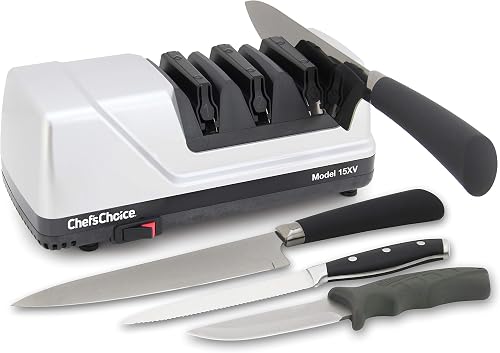
Chef'sChoice 15XV EdgeSelect Electric Sharpener
Best for 15-degree Asian-style knives - 5
 Check it
SHARPAL 191H Knife Scissors Sharpener
Best for sharpening scissors too - 6
 Check it
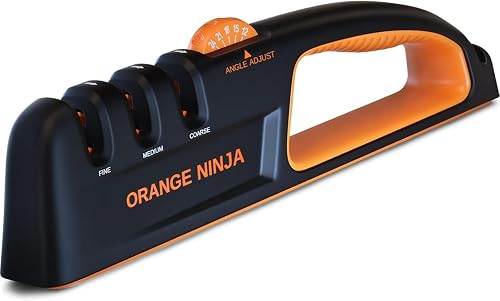
5 Precision Adjust Knife Sharpener- 3-Stage Premium
Best for adjustable sharpening angles - 7
 Check it
Sharp Pebble 1000/6000 Whetstone
Best for polished edges and blade care - 8
 Best for keeping an edge between sharpeningsCheck it
- 9
 Check it
Chef'sChoice Manual Knife Sharpener for 15 and 20 Degrees
Best for 15- and 20-degree European and Asian knives
The best knife sharpeners for kitchen knives
The AccuSharp takes the top spot for most homes because it handles both straight and serrated blades with almost no learning curve. The rest of the list fills in where a single hand-held tool falls short, from electric grinding to stone polishing.
AccuSharp Hand-Held Carbide Blade Sharpener: Best for straight and serrated edges
- Diamond-honed tungsten carbide blades
- Works on straight and serrated blades
- Full-length finger guard
- Fits either hand
A pocket-size sharpener that handles straight and serrated blades without set angles or electricity. Its guard and ergonomic handle keep the fingers clear.
Pros
- Reversible carbide blades double their life
- Full-length finger guard
- Safe in the dishwasher
Cons
- Coarse grit takes more metal than a fine hone
- The 2-pack gives you a spare you may not need
AccuSharp suits the cook who wants a dull blade usable again in seconds. Its diamond-honed tungsten carbide blades restore most straight and serrated knives in just a few strokes, so you can sharpen mid-recipe without dragging out a stone.
It covers chef's knives, paring knives, fillet knives and cleavers, plus serrated blades, which many pull-through tools skip.
The design is genuinely ambidextrous: the ergonomic handle fits either hand, and a full-length guard keeps your fingers behind the blade. The blades reverse to double their life.
It weighs just 0.09 kg and measures 7.5 by 0.87 by 9 inches, so it stores in a drawer or a knife roll.
It's also dishwasher safe, which matters if you'd rather not hand-clean a kitchen tool. The trade-off is grit.
Carbide is coarse, so it removes metal faster than a fine ceramic hone and suits restoration more than everyday touch-ups. For daily maintenance between sharpenings, a rod is the gentler tool.
The 2-pack gives you a spare for a drawer or a camping kit. For a single knife used daily, pair it with a honing rod to keep the edge aligned between sharpenings.
Presto 08800 EverSharp Electric Knife Sharpener: Best for automatic two-stage sharpening
- Two-stage grinding and honing
- Sapphirite sharpening wheels
- Precision blade guides
- Nonslip base
The Presto grinds a new edge and hones it in one pass through two slots. Its guides hold the blade at the right angle, so there is nothing to judge by eye.
Pros
- Preset guides remove the angle guesswork
- Catches metal filings in two receptacles
- A nonslip base keeps the unit steady on the counter
Cons
- Corded 120-volt unit
- Not for knives serrated on both sides
Presto's EverSharp suits anyone who would rather let the machine find the angle. Its two-stage system grinds a precisely angled edge in stage one, then hones and polishes in stage two, all with the knife drawn slowly through each slot.
The precision guides hold the blade at the ideal angle, so there's no guesswork and no angle to judge by eye.
The Sapphirite wheels are the same ultra-hard material professional sharpening shops use. A nonslip base keeps the unit steady on the counter, and two receptacles underneath catch metal filings for disposal.
It handles most non-serrated kitchen and sport knives, including alloy, carbon and stainless steel. Sparks are normal when high-carbon steel meets the wheels.
Serrated knives are the exception, so keep a hand tool for those. The corded 120-volt design means it needs an outlet nearby, and at 3 pounds it's heavier than any manual pick here, which is the main reason to choose a hand-held tool instead.
For a household with several European-style knives, the automated grind is hard to beat. If you'd rather keep it simple and manual, the hand knife sharpener for kitchen knives roundup covers the alternatives.
AnySharp: Best for hands-free everyday use
- PowerGrip suction base
- 20-degree preset angle
- Tungsten carbide blades
- No power needed
A compact pull-through sharpener that locks to smooth surfaces with a suction base. You keep both hands on the knife and the handle instead of steadying the tool.
Pros
- Suction base holds it in place
- 20-degree preset angle
- Stores in a drawer
Cons
- Needs a smooth, flat surface to grip
- Fixed angle suits European-style edges better than thin Asian blades
AnySharp suits small kitchens and cooks who want the sharpener to stay put. Its PowerGrip suction base locks to smooth surfaces, so both hands stay on the knife and handle instead of holding the tool down.
That hands-free grip is aimed at seniors, beginners and busy cooks who don't want to think about angles.
The 20-degree preset angle matches most European-style kitchen knives. Tungsten carbide blades do the cutting, and there's no cord or battery to manage.
It measures 4.33 by 6.1 by 2.76 inches and weighs 2.08 ounces, so it stores in a drawer without taking up room. It's rated for chef's knives, serrated blades and hardened steel.
The trade-off is surface dependence: a textured or curved counter won't give the suction base a grip. The fixed 20-degree angle also isn't ideal for thin Asian blades, which want a shallower edge.
For those, an adjustable or 15-degree tool is the better match.
For a rental kitchen or a small apartment, the stability is the selling point. Read the full pull through knife sharpener comparison if you want to weigh other pull-through designs.
Chef'sChoice 15XV EdgeSelect Electric Sharpener: Best for 15-degree Asian-style knives
- Three-stage EdgeSelect system
- 100 percent diamond abrasives
- Flexible spring guides
- Converts 20-degree edges to 15 degrees
The 15XV reshapes a 20-degree factory edge into a sharper 15-degree edge and polishes it in a third stage. It suits cooks who own thin Asian-style blades.
Pros
- Three stages for grinding, honing and stroking
- Patented spring guides adjust the angle
- Handles straight and serrated blades
Cons
- Premium price
- Takes about a minute on the first sharpening
Chef'sChoice's 15XV suits cooks who own Japanese-style knives and want a shallower edge. Its three-stage EdgeSelect system grinds, hones and polishes, and it converts a traditional 20-degree factory edge into a 15-degree Trizor XV edge.
The result is a longer lasting, ultra-sharp edge with three distinct facets.
All three stages use 100 percent diamond abrasives, and patented flexible spring guides adjust to keep the angle accurate along the whole blade. Stage three uses a flexible abrasive system to polish and help prolong the life of serrated knives.
Straight-edge and serrated blades are both covered.
The first sharpening takes about a minute. Resharpening takes around 10 seconds, which makes it easy to keep a rotation of knives in shape.
Chef'sChoice backs it with a 3-year limited warranty. At 4.2 pounds and about 10 inches long, it takes more counter or shelf space than a hand-held tool.
This is the premium pick in the group, so it's worth the money only if your knives are worth the care. For budget kitchens with sturdy European blades, the Presto covers the job for less.
SHARPAL 191H Knife Scissors Sharpener: Best for sharpening scissors too
- Three sharpening stages
- Tungsten carbide and ceramic blades
- Dedicated scissor slot
- Strong suction base
The 191H adds a scissor slot to the usual carbide and ceramic stages. It covers kitchen knives and household scissors from one small block.
Pros
- Sharpens scissors as well as knives
- Three stages from setting to honing
- Small footprint for drawer storage
Cons
- Suction base needs a smooth surface
- Not a match for very thin Asian edges
SHARPAL's 191H suits a drawer that needs to handle more than knives. Its three stages cover quick edge setting with tungsten carbide, precision honing with ceramic, and a dedicated tungsten carbide slot for scissors.
That last slot is the reason to pick it over the simpler hand-held tools.
The suction base is the strongest part of the design. SHARPAL says it holds with twice the force of similar tools, and it activates with a simple press on the black switch.
That hands-free grip makes it safe for right- and left-handed users and keeps your hand away from the blade.
Its small size, 2.76 by 2.36 by 2.76 inches at 3.04 ounces, means it tucks away easily. The trade-off against the AccuSharp is portability: the 191H wants a flat, smooth surface to anchor to, while the AccuSharp works anywhere in your hand.
For a home where kitchen shears and craft scissors also go dull, the extra slot earns its place. If scissors aren't a concern, the simpler hand-held picks cover knives just as well.
SHARPAL also gives it a 3-year warranty for non-commercial use.
5 Precision Adjust Knife Sharpener- 3-Stage Premium: Best for adjustable sharpening angles
- Five angle settings
- Three sharpening stages
- Ergonomic handheld body
- Straight-edge blades only
Five angle choices let you match the edge to the knife instead of forcing one angle on every blade. It's a hand-held tool, so you steady it yourself.
Pros
- Five angle settings
- Three grit stages
- Works as a kitchen, pocket or hunting knife sharpener
Cons
- Not for serrated knives or scissors
- No base or clamp, so you hold it as you pull
Sharp Pebble's 5 Precision Adjust suits cooks with a mixed knife drawer. Its five angle settings (12, 15, 18, 21 and 24 degrees) let you match the edge to each blade instead of forcing one angle on all of them.
That spread covers thin Asian blades and heavier European ones in the same tool.
Three stages take you from coarse repair to a medium hone and a fine finish. The ABS plastic and rubber body is built for extended use, and at 9.84 inches long and 1.5 ounces it fits in a drawer.
It's designed for straight-edge blades only, so serrated knives and scissors need another tool.
Because it's hand-held with no base or clamp, you steady it yourself as you pull the knife through. That's the main difference from a suction-base model like the AnySharp, and it's the reason to choose one over the other.
The upside is that you can take it anywhere and set the angle yourself.
Pair it with a pull-through technique guide to get consistent strokes at each angle setting. It's a good middle ground between a basic pull-through and a full stone setup.
Sharp Pebble 1000/6000 Whetstone: Best for polished edges and blade care
- Dual-grit 1000/6000 stone
- Angle guide included
- Bamboo base
- Water-based sharpening
A two-sided stone that repairs dull edges on the 1000 side and polishes them on the 6000. The included angle guide takes the guesswork out for first-timers.
Pros
- Dual grit in one stone
- Angle guide helps beginners
- No oil needed
Cons
- Needs a soaking and a steady hand
- Slowest method in this group
The Sharp Pebble 1000/6000 Whetstone suits the cook who wants a polished edge and doesn't mind spending ten minutes on it. The dual-grit stone repairs dull or damaged edges on the 1000 side and polishes to a razor-sharp finish on the 6000 side.
Sharp Pebble calls that combo the sweet spot for everyday knives, since it covers most home sharpening without a coarser grit.
The included angle guide locks blade position so first-timers don't have to judge the angle by feel. A non-slip bamboo base holds the stone steady, and the kit is water-based, so there's no honing oil to buy.
The box also includes an instruction manual and tips for beginners.
Sharp Pebble says the stone stays flat three times longer than cheap whetstones. That matters because a dished stone can't produce a consistent edge.
The trade-off is time: it's the slowest method here and needs soaking before use, and the 2.1-pound stone takes more storage than a pull-through.
For anyone who enjoys the process and wants edges that hold longer than an electric sharpener gives, this kit is the right starting point. It also sharpens scissors, chisels and razors.
For speed on a weeknight, choose one of the pull-through tools above.
Utopia 12-Inch Honing Rod: Best for keeping an edge between sharpenings
- 12-inch carbon steel rod
- Nickel-chrome plating
- Non-slip handle and base
- Hanging loop
A steel rod for realigning an edge that's still in good shape. It's a maintenance tool rather than a sharpener, so pair it with one of the sharpeners here.
Pros
- Long rod gives room for smooth strokes
- Handle and base keep it steady
- Hanging loop for storage
Cons
- Doesn't remove metal to fix a worn edge
- Needs drying after washing
The Utopia 12-Inch Honing Rod suits cooks who already keep their knives sharp and want to keep them that way. A 12-inch carbon steel rod plated with nickel-chrome realigns an edge that's still in good shape, so it's a maintenance tool rather than a sharpener.
The fine surface is there to protect the cutting edge rather than grind it down.
The longer rod gives you room for smooth, full strokes. An ergonomic handle fits either hand, and a slip-resistant rubber base keeps it steady on the counter.
A hanging loop makes it easy to store within reach. It's rated for kitchen, household, sporting and pocket knives, straight and serrated.
Keep in mind what a rod does: it straightens a bent edge, it doesn't remove metal to fix a worn one. A knife that's genuinely dull needs one of the sharpeners in this list first.
Wipe the rod with an oiled cloth and dry it fully after washing, and never put it in the dishwasher.
This is the tool to reach for before every big cooking session. It's also a natural partner to the AccuSharp, which does the metal removal the rod can't.
Chef'sChoice Manual Knife Sharpener for 15 and 20 Degrees: Best for 15- and 20-degree European and Asian knives
- Two-stage manual sharpening
- 100 percent diamond abrasives
- 15- and 20-degree edges
- Soft-touch handle
This manual sharpener covers both common kitchen edge angles in one compact tool. Diamond abrasives grind and polish without needing a power outlet.
Pros
- Handles 15- and 20-degree knives
- Diamond abrasives in both stages
- Compact enough for a drawer
Cons
- Manual effort and a steady hand
- Doesn't set a completely new edge like an electric
Chef'sChoice's Manual Knife Sharpener suits kitchens with both European and Asian knives. Its 15- and 20-degree settings cover both edge types, so one compact tool handles the whole drawer.
The 15-degree setting suits Asian-style blades and the 20-degree setting suits European and American ones.
The two-stage design uses 100 percent diamond abrasives in both stages, with CrissCross technology that sharpens into and out of the edge for a burr-free result. Precise bevel angle control keeps the edge consistent, and a soft-touch handle gives a secure grip.
The arch-shaped edge it creates is meant to be stronger and more durable.
It sharpens straight-edge and serrated knives as well as sport and pocket knives. At 9.25 inches long and 8 ounces, the compact footprint fits a drawer, and Chef'sChoice offers a 10-year warranty.
The trade-off against an electric is effort: you hold the tool and draw the knife yourself. Against a single-angle pull-through, the advantage is the two angle options.
For a single-angle European kitchen, the AnySharp does the same job with less to think about.
How these knife sharpeners compare
Every pick sharpens, but they split into four families: hand-held carbide tools, pull-through blocks, electric machines and stones. The comparison table shows what each one is built to do.
| Product | Best for | Type | Blade material | Grip | Our score |
|---|---|---|---|---|---|
| AccuSharp Hand-Held Carbide Blade Sharpener | straight and serrated edges | Hand-held pull sharpener | Diamond-honed tungsten carbide | Ergonomic with finger guard | 9.7 |
| Presto 08800 EverSharp Electric Knife Sharpener | automatic two-stage sharpening | Electric, two-stage | 9.6 | ||
| AnySharp | hands-free everyday use | Pull-through, hands-free | 9.6 | ||
| Chef'sChoice 15XV EdgeSelect Electric Sharpener | 15-degree Asian-style knives | Electric, three-stage | 9.2 | ||
| SHARPAL 191H Knife Scissors Sharpener | sharpening scissors too | Pull-through, three-stage | 9.1 | ||
| 5 Precision Adjust Knife Sharpener- 3-Stage Premium | adjustable sharpening angles | Hand-held, adjustable angle | 9.0 | ||
| Sharp Pebble 1000/6000 Whetstone | polished edges and blade care | Whetstone | 8.2 | ||
| Utopia 12-Inch Honing Rod | keeping an edge between sharpenings | Honing rod | 8.1 | ||
| Chef'sChoice Manual Knife Sharpener for 15 and 20 Degrees | 15- and 20-degree European and Asian knives | Manual, two-stage | 8.0 |
The split matters more than any single spec. A hand-held carbide tool like the AccuSharp is the fastest way to bring back a dull edge, and it's the only family here that travels well.
A pull-through block such as the AnySharp or the SHARPAL 191H trades that portability for a suction base that holds the tool still while you work. Electric machines like the Presto and the 15XV take the angle out of your hands entirely, at the cost of a cord and counter space.
The whetstone sits at the far end: the most control and the finest edge, but the most time and practice.
Within each family, the differences come down to angle coverage and blade coverage. The AccuSharp and the SHARPAL 191H handle serrated edges; the Sharp Pebble 5 Precision Adjust and the Chef'sChoice manual handle multiple angles; the whetstone is the slowest and least suited to serrated blades.
The honing rod is the outlier: it maintains an edge rather than creating one, so it works alongside any of the others.
How we compared these knife sharpeners
We weighed each sharpener by how well it matches a real home kitchen job: restoring a dull blade, holding an angle for you, or maintaining an edge between sessions. Specs and features decided the order, with the tool that covers the most common needs ranked first.
The first question was angle control. Tools that set or guide the angle for you scored higher than ones that leave it to your hand, because most home cooks don't sharpen often enough to hold a steady angle by feel.
The AccuSharp and the two Chef'sChoice tools all build the angle into the design. The Sharp Pebble 5 Precision Adjust and the whetstone leave it to you, with settings or a guide to help.
Next came blade coverage. A sharpener that handles straight and serrated edges in one tool covers more of a typical knife drawer than one limited to straight edges.
That lifted the AccuSharp and the SHARPAL 191H, while it counted against the Sharp Pebble 5 Precision Adjust, which is straight-edge only.
Finally we weighed upkeep. Dishwasher-safe parts, bases that hold steady and easy storage all count in daily use.
Speed and polish rounded out the ranking, with stones scoring lower for the time they take even though they produce the finest edge. Warranty coverage, like the Chef'sChoice 15XV's 3-year limited warranty, went into the same balance.
Which type of knife sharpener suits your kitchen?
A hand-held carbide tool is the right first sharpener for most homes. It's cheap, fast, needs no power and handles serrated blades.
Electric machines suit households with several knives and no interest in learning an angle. Stones suit cooks who want the best possible edge and don't mind the time.
Should you choose a pull-through or a hand-held sharpener?
Choose a hand-held sharpener if you want one tool that works anywhere and handles serrated edges. Choose a pull-through block with a suction base if you'd rather have the tool hold itself steady on the counter.
The difference is where your hands go: with a hand-held tool both hands work the knife and the sharpener together, while a suction-base block leaves both hands free for the knife.
Is an electric sharpener worth it for a home kitchen?
Yes, if you sharpen several knives regularly and want a consistent angle every time. An electric like the Presto grinds and hones in one pass.
For one or two knives used now and then, a manual tool is enough. Electric units also need an outlet nearby and take more counter space, so a small kitchen may not have room to leave one out.
Do you need a power outlet for a good edge?
No. The AccuSharp, the AnySharp, the SHARPAL 191H, the Sharp Pebble 5 Precision Adjust, the whetstone and the honing rod all work without power.
The two electric machines here are the Presto and the Chef'sChoice 15XV. If your kitchen is short on outlets or you want a tool for camping, the manual options cover the job.
What edge angle do your kitchen knives need?
Check the knife before you buy a sharpener. European-style blades are usually ground at 20 degrees per side.
Japanese-style blades are often 15 degrees or less. A fixed-angle sharpener that doesn't match the blade will grind a steeper edge than the knife was made with.
The 20-degree tools here are the AnySharp and the SHARPAL 191H. The 15-degree tools are the Chef'sChoice 15XV.
The Chef'sChoice manual and the Sharp Pebble 5 Precision Adjust handle both, one with two settings and the other with five. A whetstone and a honing rod leave the angle entirely to your hand.
How do you tell which angle your knife uses?
Look up the maker's stated angle if you know the brand. If you don't, judge by the blade: thin, hard Japanese knives want a shallower edge, while heavier European knives take the 20-degree standard.
When in doubt, an adjustable sharpener covers both. The Sharp Pebble 5 Precision Adjust's five settings from 12 to 24 degrees give you room on either side.
What happens if you use the wrong angle?
The sharpener grinds a new edge at its own angle, so a 20-degree tool on a 15-degree knife removes more metal than needed and changes the blade's geometry. Over repeated use the knife gets thicker behind the edge and cuts less cleanly.
For an expensive knife, that's the mistake worth avoiding.
How often should you sharpen versus hone?
Sharpen when the blade stops biting. Hone more often to keep an edge straight between sharpenings.
A tomato skin is the easiest test: if the knife slides instead of catching, it's time.
The honing rod is the tool for the in-between weeks. It takes seconds and doesn't remove metal, so you can use it before every big cooking session without wearing the edge down.
Save the carbide and electric sharpeners for when honing no longer brings the edge back.
When is a honing rod the right tool?
Use a rod when the edge is still sharp but feels slightly rounded or sluggish. The Utopia rod straightens the edge without removing metal.
If the knife is genuinely dull and won't cut paper cleanly, reach for a sharpener first and the rod after. The rod's nickel-chrome plating and fine surface are built for that light realignment, not for grinding.
How do you keep a sharpener working well?
Clean the sharpener as the maker instructs. The AccuSharp is dishwasher safe, while the Utopia rod should be wiped with an oiled cloth and dried fully, never put in the dishwasher.
The Presto catches filings in receptacles underneath, so empty them. A whetstone should be soaked before use and kept flat so it doesn't dish.
Will a sharpener damage an expensive knife?
Only if the angle or grit is wrong for the blade. A coarse carbide pull-through removes metal quickly and will wear a fine Japanese edge down over time.
For expensive knives, choose an adjustable or 15-degree sharpener and keep the heavy grinding for cheaper blades.
The AccuSharp's coarse carbide is the fastest restorer here, and that's also why it's the least gentle on a delicate edge. For a thin Japanese blade, the Chef'sChoice 15XV or the 15-degree setting on the Chef'sChoice manual is the safer match.
For a European workhorse, the 20-degree tools are fine.
Can you sharpen serrated knives at home?
Yes, with a tool made for them. The AccuSharp and the SHARPAL 191H both handle serrated edges.
Work the sharpener along the beveled side of each serration and leave the flat side alone. A stone or a straight-edge-only sharpener won't do the job.
The Chef'sChoice 15XV and the Chef'sChoice manual also list serrated blades among the knives they handle.
Is a whetstone safer for a good knife?
A stone gives you the most control over the angle and removes metal slowly, so it's the gentlest method in the right hands. The catch is consistency: without a steady angle, a stone can round an edge as easily as sharpen it.
The Sharp Pebble kit's angle guide helps, but it still rewards practice.
Do you need a stone for a truly sharp edge?
A stone gives the finest, longest-lasting edge, but it's the slowest method and needs practice. For most home cooks, a pull-through or electric sharpener reaches "sharp enough" faster.
A stone earns its place if you already enjoy sharpening as a routine.
The Sharp Pebble kit's 6000-grit side polishes to a finish sharper than most people get from a pull-through. But a 1000-grit repair followed by a few strokes on the 6000 side takes about ten minutes, plus soaking.
A pull-through gets a usable edge in seconds. The stone is for the cook who wants the edge, not just the speed.
Is a whetstone hard to learn?
Not with an angle guide. The Sharp Pebble kit includes one that holds the blade position, so beginners can get a usable edge on the first try.
It still takes about ten minutes and a soaking before each session. Sharp Pebble says beginners reach a razor-sharp edge in that time, and results improve with each session.
When is a stone worth the extra time?
When your knives are worth the care and you sharpen regularly enough to keep the skill. For a single everyday knife that gets a quick touch-up once a month, a pull-through is the practical choice.
For a collection of good blades and a cook who enjoys the ritual, the stone pays off in edge quality and in the cost of pro sharpening it replaces.
The best knife sharpener for kitchen knives: the verdict
The best knife sharpener for kitchen knives for most homes is the AccuSharp, because it covers straight and serrated blades in seconds, needs no outlet and stays safe in the hand. Buy the Presto if you'd rather the machine hold the angle on a drawer full of European knives.
Pick the AnySharp for hands-free stability, the SHARPAL 191H if scissors matter, or the Chef'sChoice 15XV for thin Asian blades. For an edge you polish yourself, the Sharp Pebble whetstone is the slow, rewarding choice.
Whichever you pick, keep a honing rod nearby and learn to use a pull-through sharpener properly so the edge lasts between sessions.
Our top 3 picks at a glance
-
1
Best for straight and serrated edges
AccuSharp Hand-Held Carbide Blade Sharpener
9.7/10 our score
See it on Amazon -
2
Best for automatic two-stage sharpening
Presto 08800 EverSharp Electric Knife Sharpener
9.6/10 our score
See it on Amazon -
3
Frequently asked questions
Is a pull-through sharpener bad for kitchen knives?
Not necessarily. A pull-through sharpener with carbide blades removes metal quickly, so frequent heavy use wears an edge down faster.
Use it to restore a dull blade and keep the light honing for a rod or a fine ceramic slot.
How often should I sharpen my kitchen knives?
Sharpen when the blade stops biting into a tomato skin or slides over an onion instead of catching. Home cooks who use one knife daily often sharpen every few months and hone more often in between.
Do electric knife sharpeners work better than manual ones?
Electric sharpeners remove metal at a steady angle with less skill from you. Manual tools cost less and store easily.
For most homes the deciding factor is whether you want to set an angle yourself or have the machine hold it.
Will a sharpener work on my Japanese knife?
Only if the angle matches. Japanese-style blades are often ground at 15 degrees or less, so choose a sharpener with an adjustable angle or a 15-degree setting.
A fixed 20-degree pull-through will grind a steeper edge than the knife was made with.


