8 Best Hand Knife Sharpeners for Kitchen Knives (November 2026)
The best hand knife sharpeners for kitchen knives include the AccuSharp Hand-Held Carbide Blade Sharpener for most kitchen knives, the AnySharp for hands-free safety, and the Smith's PP1 Pocket Pal Knife Sharpener Preset for camping and small kitchens.
On this page (5 sections)
The best hand knife sharpener for kitchen knives is the AccuSharp Hand-Held Carbide Blade Sharpener, which restores straight and serrated blades in a few strokes. Pick AnySharp for hands-free suction stability, and the SHARPAL 191H if you also want to sharpen kitchen scissors.
Hand sharpeners fall into a few families: carbide pull-through models, ceramic pull-through models, suction-base tools, and rolling kits. The right one depends on how dull your knives get and how much control you want.
Every pick here is manual, so you supply the motion and the tool supplies the abrasive, the angle guidance or both. That keeps them drawer-sized, and it means the design has to help you hold a steady angle.
Our picks at a glance
-
1
 Best for most kitchen knives
AccuSharp Hand-Held Carbide Blade Sharpener
9.7/10 our score
See it on Amazon -
2

-
3
 Best for camping and small kitchens
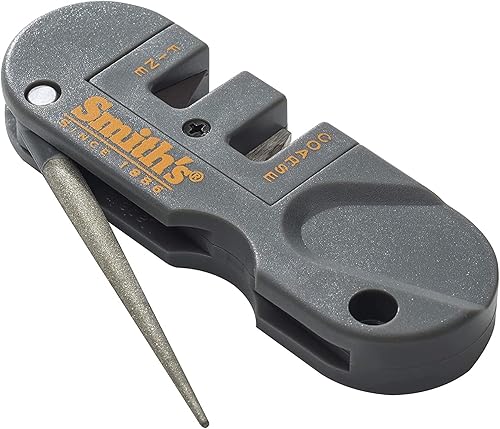
Smith's PP1 Pocket Pal Knife Sharpener Preset
9.4/10 our score
See it on Amazon
- 4
 Check it
SHARPAL 191H Knife Scissors Sharpener
Best for knives and scissors - 5
 Check it
Longzon 5-in-1 Knife Sharpener 4 Stage
Best for a full edge refresh - 6
 Best for maintaining an edgeCheck it
- 7
 Check it
Henckels Handheld Knife Sharpener
Best for simple two-stage use - 8
 Check it
AIERLIAN Rolling Knife Sharpener Kit
Best for constant-angle sharpening
The best hand knife sharpeners for kitchen knives
AccuSharp is the all-round choice for most drawers, while the rest cover particular needs like scissors, serrations, edge maintenance and angle consistency. Decide what your blades need first, then match the tool.
AccuSharp Hand-Held Carbide Blade Sharpener: Best for most kitchen knives
- Diamond-honed tungsten carbide blades
- Works on straight and serrated edges
- Reversible sharpening blades
- Two-pack
- Full-length finger guard
A pull-through design that brings most kitchen blades back to a working edge in a few strokes. The guard and reversible carbides make it the safest everyday pick here.
Pros
- Handles straight and serrated blades
- Reversible blades double the life
- Fits right- and left-handed users
- Dishwasher safe
Cons
- Coarse carbide removes metal faster than ceramic
- No fine honing stage
AccuSharp suits a kitchen with a mix of chef's knives, paring knives and the odd serrated blade. The diamond-honed tungsten carbide cutters handle straight and serrated edges, so you can sharpen the whole block with one tool.
Two crossed carbides at a preset angle do the work as you pull the blade through.
The handle fits either hand, and a full-length guard keeps your fingers off the blade when you pull toward yourself at speed. Left-handed cooks get the same grip as right-handed ones.
Its blades reverse for double the working life. AccuSharp says most users go 5 to 10 years between blade changes, and the tool can be cleaned in soapy water or the dishwasher.
At 7.5 by 0.87 by 9 inches and 0.09 kg, it grips well but still tucks in a drawer.
The two-pack is the quiet advantage. One can live in the kitchen and the other in a toolbox or camper, so you never hunt for it mid-recipe.
The trade-off is that carbide is coarse. It removes metal quickly and leaves a working edge rather than a polished one, so finish with a rod for a finer bite.
Against the ceramic-only Henckels, it is faster on a dull blade but harder on the steel. Against the rolling kit, it gives up precision for speed.
For most home cooks that is the right trade.
AnySharp: Best for hands-free safety
- PowerGrip suction base
- 20-degree preset angle
- Works on chef's, serrated and hardened steel knives
- No cord or batteries
The suction base locks to a smooth counter so you pull the knife through with one hand. That keeps fingers away from the edge and makes it a strong pick for beginners.
Pros
- Locks to smooth surfaces
- Preset angle removes guesswork
- Compact drawer storage
- Good for seniors and new cooks
Cons
- Needs a smooth, flat surface to grip
- Single fine stage only
AnySharp suits anyone who wants both hands free, or who finds holding a small sharpener awkward. Its PowerGrip suction base locks to a smooth counter, and you pull the knife through with one hand while the tool stays put.
The brand aims this at people who are wary of blades, and the hands-free stance is the reason.
The preset 20-degree angle suits most Western kitchen knives. You don't guess the angle or hold the sharpener steady, so results stay consistent from the first knife to the tenth.
That fixed angle is the whole design: remove the variables a beginner struggles with and leave only the pull.
It handles chef's knives, serrated edges and hardened steel, according to AnySharp. The compact body measures 4.33 by 6.1 by 2.76 inches and weighs just over 2 ounces, so it stores easily.
There is no cord or battery.
The grit is classed as fine, so this is a touch-up tool more than a rescue tool. On a truly dull blade, expect more passes than the coarse carbide tools need.
The catch is surface type. The suction needs a smooth, flat counter to seal, so textured stone or butcher block will not hold it.
If your counter is rough, a handheld model is the better buy. Against the SHARPAL, it lacks the scissors slot and the extra coarse stage.
Against the AccuSharp, it trades portability for stability. Pick it if you sharpen in one spot on a smooth counter.
Smith's PP1 Pocket Pal Knife Sharpener Preset: Best for camping and small kitchens
- Two-stage carbide and ceramic slots
- Fold-out diamond-coated rod
- Preset sharpening angles
- Lanyard hole
- Weighs 1 oz
A pocket-sized multi-tool that covers coarse sharpening, ceramic honing and serrations in one body. It suits small drawers, tackle boxes and anyone who sharpens away from home.
Pros
- Three sharpening surfaces in one tool
- Tiny and light enough to carry
- Diamond rod reaches serrations and gut hooks
- Reversible, replaceable stones
Cons
- Small size gives less leverage than a full handle
- Carbide slot is for straight edges only
Smith's PP1 suits campers, RV owners and small kitchens where drawer space is tight. At 1 oz, it disappears into a pocket or glove box and still covers coarse, fine and serrated work.
Closed, it measures 3.24 by 0.46 by 1.11 inches, closer to a penknife than a kitchen gadget.
The preset carbide slot sets a quick edge on dull straight blades, while the ceramic stones polish and can be used on serrated edges. The crossed angles mean you do not have to find the angle yourself when sharpening on a tailgate or picnic table.
A fold-out diamond-coated rod reaches into serrations, gut hooks and fish hooks. That rod earns it a place beyond the kitchen, handling curved edges flat slots cannot reach and suiting fishing knives as well as bread knives.
The stones are reversible and replaceable, so it keeps working. A lanyard hole lets you clip it to a pack, and Smith's backs it with a 3-year limited warranty.
The trade-off against a full-size handle is grip. The small body gives less leverage on a very dull chef's knife, and the carbide slot is for straight edges only.
Treat it as a portable backup or a small-kitchen primary. Against the AccuSharp, it adds serration reach and portability but loses comfort on long jobs.
SHARPAL 191H Knife Scissors Sharpener: Best for knives and scissors
- Three stages: coarse, ceramic, scissors
- Suction base
- Small footprint
- Works right- or left-handed
The extra slot sharpens kitchen shears along with knives, so one small tool handles the whole drawer. Its suction base presses down to lock onto a smooth counter.
Pros
- Dedicated scissors slot
- Suction base holds it steady
- Compact and easy to store
- Coarse then ceramic edge
Cons
- Needs a smooth surface for the suction base
- Fewer stages than some multi-slot tools
SHARPAL's 191H suits a kitchen where scissors get as much use as knives. Its third slot is cut for sharpening scissors, so kitchen shears, craft scissors and pruning snips all get a pass.
That slot is the reason to pick this model over the other multi-stage tools here.
SHARPAL says the suction base holds twice as firmly as similar tools, and a black switch activates it. You press the switch to lock it down, which keeps both hands on the work and suits right- and left-handed users alike.
The stages run from tungsten carbide for a quick edge to ceramic for honing. The body measures 2.76 by 2.36 by 2.76 inches and weighs about 3 ounces.
SHARPAL backs it with a 3-year warranty for non-commercial use.
The trade-off is that it is a single unit rather than a pack, and the suction still needs a smooth, flat surface. It also offers fewer stages than the Longzon's four.
Compared with the AccuSharp, it offers more stages and a scissors slot but no spare second unit. Choose it if scissors are part of the job.
Longzon 5-in-1 Knife Sharpener 4 Stage: Best for a full edge refresh
- Four stages including scissors
- Non-slip base
- Cut-resistant glove included
- Works on kitchen and pocket knives
Four grits take a dull blade from repair to polish in one pass, and the included glove is a real bonus for anyone nervous about hand sharpening. It suits cooks who want a staged refresh.
Pros
- Four stages for coarse to fine work
- Scissors slot included
- Cut-resistant glove in the box
- Non-slip base
Cons
- More stages mean more passes per knife
- Glove sizing is one size
Longzon's 4-stage tool suits anyone who wants a dull knife fully refreshed in one sitting. The four stages run from coarse grinding through fine and precision grinding, with a separate slot for scissors.
The order matters: start coarse, finish precision.
A non-slip base keeps it steady on the counter, and the box includes a cut-resistant glove for extra protection. That glove is a thoughtful add for beginners or anyone nervous about hand sharpening.
The body is built from ABS with ceramic and tungsten steel abrasives, and it fits a kitchen drawer at 9.06 by 3.07 by 1.73 inches. At 310 g it has more heft than the pocket tools and feels planted during a session.
Longzon pitches it as a gift, and the presentation matches that.
The trade-off is time per knife. More stages mean more passes, so a full refresh takes longer than a single coarse pull.
It also has more slots to learn than a two-stage tool. It suits occasional deep tune-ups more than quick weekly touch-ups.
Against the SHARPAL, it offers an extra stage and the glove but a larger footprint. Against the AccuSharp, it is slower but gentler and more thorough.
Utopia 12-Inch Honing Rod: Best for maintaining an edge
- Nickel-chrome plated carbon steel
- Non-slip rubber base
- Hanging loop
- Works on straight and serrated blades
A rod realigns an edge that has rolled between sharpenings, so blades stay usable longer. It works best alongside a sharpener rather than as a replacement for one.
Pros
- Realigns edges without removing much steel
- Long 12 in rod for kitchen blades
- Rubber base stays put
- Hanging loop for storage
Cons
- Does not restore a badly dull edge
- Needs a steady hand for the angle
The Utopia rod suits cooks who already own a sharpener and want to keep edges aligned between sessions. A 12 in nickel-chrome plated carbon steel rod gives you room to run a chef's knife along it at a steady angle.
The longer rod also keeps your knuckles clear of the counter.
The fine surface is designed to protect the cutting edge rather than remove metal. That makes it a maintenance tool: it realigns a rolled edge but will not bring a badly dull knife back.
The nickel-chrome plating over carbon steel is what gives it that smooth face.
An ergonomic handle and slip-resistant rubber base help it stay put, and a hanging loop keeps it within reach. Utopia recommends wiping it with an oiled cloth and drying it fully rather than dishwashing it, because water left on carbon steel is the enemy.
Compared with the pull-through tools here, the rod asks more skill and rewards it with longer edge life. You hold the knife at roughly the rod's angle and draw it down and across in a smooth stroke.
Get it right and you touch up an edge in seconds without grinding away steel. Pair it with a carbide sharpener for the full routine.
Against the rolling kit, it takes less space but gives you no angle support.
Henckels Handheld Knife Sharpener: Best for simple two-stage use
- Coarse and fine ceramic grits
- Contoured handle
- Safety grip
- Non-slip rubberized base
Two labeled slots make the routine easy to remember: coarse to repair, fine to finish. The contoured handle and safety grip suit cooks who want a familiar kitchen brand.
Pros
- Labeled coarse and fine slots
- Handle keeps fingers clear
- Rubberized base resists sliding
Cons
- Ceramic only, no carbide for very dull blades
- Larger footprint than pocket models
Henckels suits cooks who want a familiar two-slot routine with clear labels. The coarse and fine ceramic grits are marked for easy use, and the contoured handle keeps your hand well back from the blade.
The labels remove the guesswork in a household where several people sharpen.
A safety grip and a rubberized non-slip base add stability, and the tool works for both left- and right-handed users. It measures 8.5 by 7.7 by 2 inches and weighs 8 ounces, so it feels solid in the hand.
The brand has made kitchen knives since 1895, and this sharpener is built to match that heritage rather than to be a throwaway gadget.
The all-ceramic setup is gentler on blades than carbide, which suits knives you want to keep for years. It is also slower to bring back a very dull or chipped edge.
Ceramic removes steel at a measured pace, so it protects the blade but asks for patience.
Compared with the Longzon, it offers fewer stages and no scissors slot, but the labeled slots make it easier for a household where several people sharpen. Against the AccuSharp, it is the gentler choice for good knives but the weaker choice for a neglected drawer.
Choose it for straightforward upkeep.
AIERLIAN Rolling Knife Sharpener Kit: Best for constant-angle sharpening
- #400 diamond and #3000 ceramic discs
- 15 and 20 degree magnetic angle supports
- Leather strop included
- Wood base with strong magnets
The rolling disc holds a fixed angle across the edge, which suits cooks who want a more consistent result than a pull-through gives. It takes more counter space and a little practice.
Pros
- Two angle options, 15 and 20 degrees
- Diamond disc removes steel quickly
- Strop refines the final edge
- Strong magnets hold the knife
Cons
- Needs a flat counter and setup time
- Cannot sharpen serrations or scissors
AIERLIAN's rolling kit suits cooks who want a fixed angle and are willing to spend a few minutes per knife. The blade sits on a magnetic wood support at 15 or 20 degrees, and you roll the diamond and ceramic discs along the edge.
The N42 magnets are strong enough to hold the knife still while you work.
The 20-degree setting fits most household knives, while 15 degrees suits knives you want very sharp. The diamond disc removes steel quickly, then the ceramic disc polishes.
A leather strop finishes the edge and clears fine burrs. The #400 diamond and #3000 ceramic grits are a wide jump that takes the edge from reshaping to refining.
The kit takes more counter space than a pull-through and needs a flat surface for the magnets to hold. Setup takes a moment, and the rolling motion takes practice to keep even along the whole edge.
AIERLIAN says it cannot sharpen serrations or scissors.
It rewards patience with a more even edge than a quick pull-through gives, which makes it a serious option for a cook with a few good knives. Against the AccuSharp, it is slower and fussier but more consistent.
Against the Utopia rod, it gives you angle support but needs more room. The included strop and gift box make it the most complete kit here.
How these hand sharpeners compare
The table puts the main specs side by side so you can compare grit types, size and which tools add extras like scissors slots or a strop.
| Product | Best for | Grit type | Material | Size | Our score |
|---|---|---|---|---|---|
| AccuSharp Hand-Held Carbide Blade Sharpener | most kitchen knives | Coarse | Plastic, tungsten carbide | 7.5 x 0.87 x 9 in | 9.7 |
| AnySharp | hands-free safety | Fine | Plastic, tungsten carbide | 4.33 x 6.1 x 2.76 in | 9.6 |
| Smith's PP1 Pocket Pal Knife Sharpener Preset | camping and small kitchens | Coarse, fine | Plastic | 3.24 x 0.46 x 1.11 in | 9.4 |
| SHARPAL 191H Knife Scissors Sharpener | knives and scissors | Fine | Ceramic, tungsten carbide | 2.76 x 2.36 x 2.76 in | 9.1 |
| Longzon 5-in-1 Knife Sharpener 4 Stage | a full edge refresh | Ultra fine | Ceramic, tungsten steel | 9.06 x 3.07 x 1.73 in | 8.4 |
| Utopia 12-Inch Honing Rod | maintaining an edge | Fine | Carbon steel | 12 in rod | 8.1 |
| Henckels Handheld Knife Sharpener | simple two-stage use | Coarse, fine | Plastic, ceramic | 8.5 x 7.7 x 2 in | 7.7 |
| AIERLIAN Rolling Knife Sharpener Kit | constant-angle sharpening | Medium | Wood | 5.49 x 4.6 x 2.7 in | 7.2 |
How we compared these sharpeners
We compared the specs and features each maker publishes, then weighed them against the job each model is built for. The score reflects how well the tool fits a home cook sharpening kitchen knives.
We did not test the tools on our own blades, so the ranking leans on what each design is built to do. Grit type, number of stages, footprint, grip and safety features carried the most weight.
A dedicated scissors slot or a two-pack counted as a real advantage because it covers a need without a second purchase. Price was not a factor, since the tools here sit in a similar range.
What separated them was how much of the work the design does for you: a suction base or a preset angle lowers the skill needed, while a rod or a rolling kit asks more of the cook and gives more control in return.
What should you look for in a hand knife sharpener?
Start with the blades you own, then match the sharpening stage to them. A drawer full of serrated bread knives needs a different tool from a set of straight chef's knives.
The questions below cover the choices that matter most.
Carbide or ceramic: which stage do you need?
Carbide cuts fast; ceramic refines. Carbide slots restore a dull or damaged edge quickly and suit knives that see hard use.
Ceramic slots hone and polish, which suits knives you want to keep sharp with light upkeep.
Carbide takes more steel off the blade, ceramic takes less.
Many tools here combine both. The AccuSharp and SHARPAL use carbide for the first pass, while the Henckels uses ceramic for both slots, which is gentler but slower on a very dull blade.
The Longzon goes further with four stages, adding precision grinding after the fine stage. The Smith's PP1 pairs carbide and ceramic and adds a diamond rod on top.
If your knives are mostly in good shape, ceramic alone is enough. If you regularly let blades go dull, a carbide stage saves time.
Should you pick a suction base or a handheld tool?
A suction base gives hands-free stability; a handheld tool goes anywhere. Suction models like AnySharp and the SHARPAL lock to a smooth counter, which keeps both hands on the knife and suits beginners.
The base holds the tool while you pull the blade through with one hand.
Handheld models like the AccuSharp and the Smith's PP1 work on any surface, including a cutting board or a campsite table. The trade-off is that you hold the tool and the knife at once, so a firm grip matters.
A full-length guard on the AccuSharp and a safety grip on the Henckels help there. Pick suction if your counter is smooth and you sharpen in one spot.
Pick handheld if you move around or have a textured counter. A rolling kit sits in between: it needs a flat counter for its magnetic base but gives you a guided angle rather than a locked-down tool.
Do you need a dedicated scissors slot?
It helps if kitchen shears are part of your routine. The SHARPAL 191H and Longzon both include a slot cut for scissors, which saves you from buying a second tool.
Kitchen shears dull the same way knives do, and they are easy to forget until they start crushing herbs instead of snipping them.
The SHARPAL's scissors slot is a separate tungsten carbide blade in the same small body. The Longzon gives scissors their own position at the head of its four-stage sequence.
If you rarely sharpen shears, a two-slot knife sharpener covers the job.
Is a honing rod worth adding?
Yes, if you want edges to last. A rod realigns a rolled edge between sharpenings, which means your knives stay usable longer and need full sharpening less often.
An edge that feels dull is often just bent over at the microscopic level, and a few strokes on a rod can straighten it without removing steel.
The Utopia 12 in rod is a low-cost way to build that habit. Use it weekly and reach for the carbide or ceramic sharpener only when the edge stops biting.
The rod maintains, the sharpener restores. A kitchen with both gets more life out of every blade.
Can one sharpener handle serrated and straight blades?
Some can, some cannot. The AccuSharp runs straight and serrated edges through the same carbide cutters.
The Smith's PP1 covers serrated edges in its ceramic slot and reaches scallops with its round diamond rod.
The Longzon is aimed at standard blades. The AIERLIAN rolling kit cannot sharpen serrations or scissors at all, while AnySharp's single fine stage can still handle serrated edges, according to the manufacturer.
If you own bread knives or a serrated utility knife, check that the tool names serrations as a job it does. A serrated edge sharpens on the scallop faces, so a rod or round abrasive often fits better than a flat slot.
Verdict
The best hand knife sharpener for kitchen knives for most homes is the AccuSharp Hand-Held Carbide Blade Sharpener. It handles straight and serrated edges, fits either hand, and the two-pack means one can live in the drawer and one in a bag.
It is the fastest path from a dull blade to a working one.
Choose AnySharp if you want a hands-free suction base for a smooth counter. Choose the SHARPAL 191H if scissors matter, the Smith's PP1 for a portable kit, and the Utopia rod to maintain edges between sharpenings.
The Longzon suits a full staged refresh and the Henckels a gentle ceramic routine. For a slower, more controlled result, the AIERLIAN rolling kit suits a cook with a few good knives and some patience.
Whichever you buy, keep the coarse stage for occasional work and finish with ceramic or a rod to protect the edge. A sharp knife is a safer knife, and a small tool that makes sharpening easy is the one you will actually reach for.
Our top 3 picks at a glance
-
1
Best for most kitchen knives
AccuSharp Hand-Held Carbide Blade Sharpener
9.7/10 our score
See it on Amazon -
2
-
3
Best for camping and small kitchens
Smith's PP1 Pocket Pal Knife Sharpener Preset
9.4/10 our score
See it on Amazon
Frequently asked questions
Are pull-through sharpeners bad for knives?
They remove metal faster than a stone, so use the coarse slot less often and finish with ceramic or a rod. For most home cooks that metal loss is small enough to accept for the convenience.
Can I use one sharpener on serrated knives?
The AccuSharp and Smith's PP1 both handle serrated edges, with Smith's adding a round diamond rod for the scallops. Check that the slot you use is meant for serrations before running the blade through.
How often should I sharpen kitchen knives?
Hone weekly with a rod and sharpen when the edge stops biting into a tomato skin. A dull knife slips more, so a light touch-up beats waiting for total dullness.
Does a suction-base sharpener work on any counter?
It needs a smooth, flat surface like granite, tile or glass. On textured or wooden counters the base will not seal, so choose a handheld model instead.